Trump Gold Card Visa Cost: Complete 2026 Breakdown
The United States has long attracted wealth seekers through immigration pathways, but a new program has ignited widespread discussion: the Trump Gold Card visa, requiring a $1 million non-refundable gift to the Department of Commerce. Launched in December 2025, this premium residency pathway promises expedited access to American life for high-net-worth individuals. For applicants weighing their options, the critical question isn’t simply whether they can afford it, but whether $1 million delivers genuine value compared to alternatives like the EB-5.
This comprehensive guide breaks down exactly what the Gold Card costs, how it compares to the EB-5 visa and international golden visa programs, and who stands to benefit most from this pathway. Important distinction: The Gold Card payment is a non-refundable gift to the U.S. Department of Commerce—it is not an investment that can be recovered.
Estimate Your Total Cost
Gold Card Visa Cost Calculator
Estimate the total cost of your Gold Card visa application
Disclaimer: These are estimates only. Actual costs may vary based on individual circumstances, attorney rates, and additional filing requirements. Consult a qualified immigration attorney for exact costs specific to your situation.
Free Gold Card Visa Guide
Get our Gold Card guide with cost breakdowns, timelines, and attorney tips. Delivered instantly to your inbox.
No spam. Unsubscribe anytime.
What Is the Trump Gold Card Visa?
The Gold Card is a new immigration pathway launched by President Trump in December 2025. Unlike the EB-5 investor visa that requires job creation or specific capital deployment, the Gold Card functions as a premium residency-by-contribution program. Applicants make a non-refundable gift to the Department of Commerce in exchange for permanent residency. The application form is the I-140G (not the I-526 used for EB-5). See our step-by-step application guide for the full process. The program is live and accepting applications at trumpcard.gov.
Under the program, foreign nationals who contribute $1 million (Individual Gold Card) receive a pathway to permanent residency (a green card), with potential expedited naturalization timelines. The program offers three tiers:
- Individual Gold Card: $1 million gift + $15,375 processing fees ($15,000 + $375) per person — LIVE now
- Corporate Gold Card: $2 million corporate pathway gift + $15,000 per employee + 5% transfer fee + 1% annual maintenance — LIVE now
- Platinum Card: $5 million Platinum Card — NOT YET AVAILABLE, waitlist only. This is a separate product that grants non-immigrant visitor status (NOT a green card) and is pending Congressional approval
The payment is made AFTER vetting is complete—it is not paid upfront.
Last Updated: February 2026. Program details may change. This article is for informational purposes only.
Gold Card Cost Breakdown
Understanding what each tier actually covers requires distinguishing between the gift amount and associated program costs. The Gold Card payment is a non-refundable gift to the Department of Commerce—this is not an investment, and the money cannot be recovered.
Individual Gold Card — Tier Structure
| Tier | Gift Amount | Mandatory Fees | Status | What You Get |
| Individual Gold Card | $1,000,000 | $15,375 per person ($15,000 + $375) | LIVE | Green card (permanent residency) |
| Corporate Gold Card | $2,000,000 | $15,000/employee + 5% transfer fee + 1% annual maintenance | LIVE | Green card (permanent residency) |
| Platinum Card | $5,000,000 | TBD | NOT AVAILABLE — waitlist only | Non-immigrant visitor status (NOT a green card) |
Direct Gift Requirement
The core $1 million (Individual tier) is a non-refundable gift to the Department of Commerce. Unlike the EB-5 program where your investment is capital at risk in a business, the Gold Card payment:
- Is a non-refundable gift — you will not get this money back
- Is paid AFTER vetting is complete, not upfront
- Does not require job creation or specific capital deployment
- Is filed via Form I-140G
Mandatory Processing Fees
In addition to the gift amount, every applicant must pay a $15,375 processing fee ($15,000 + $375) per person. This is mandatory and non-negotiable.
Family Coverage: Critical Cost Consideration
Each family member needs their OWN $1 million gift + $15,375 processing fee. Unlike the EB-5 where derivative beneficiaries are included, the Gold Card requires separate gifts per person. A family of four would need approximately $4 million+ in gifts plus processing fees—a critical consideration for family planning.
Additional Costs Beyond the Gift
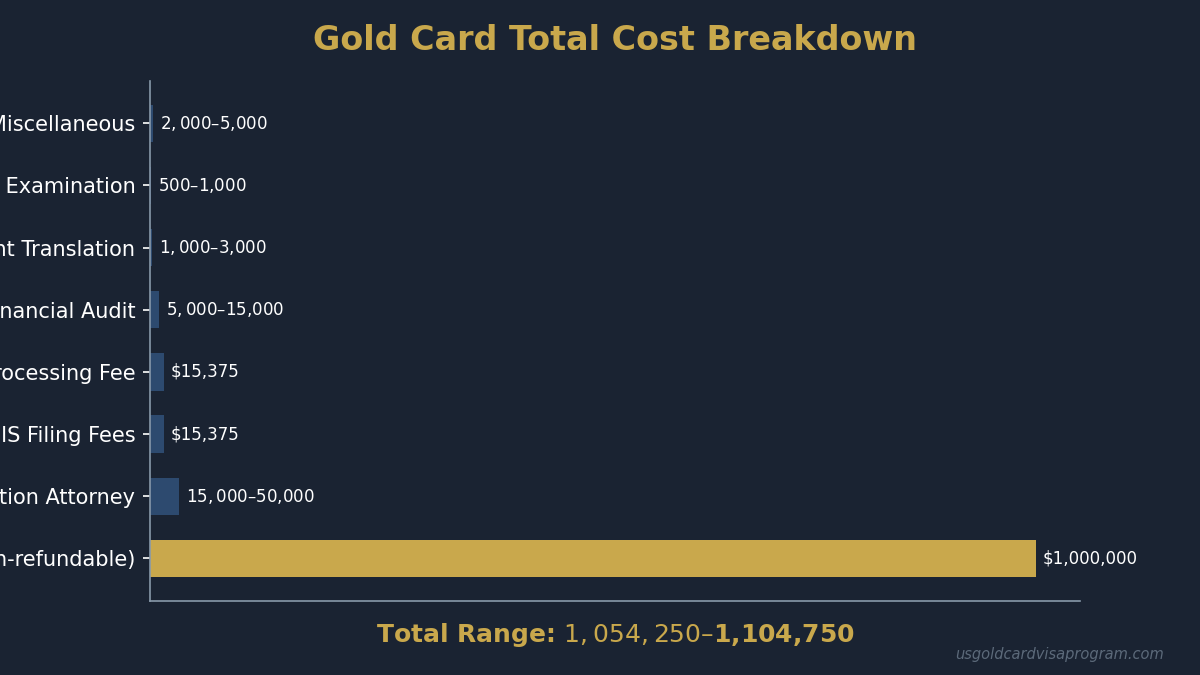
Applicants should anticipate several supplementary expenses (and should also prepare their source of funds documentation):
| Cost Category | Estimated Range |
| Mandatory processing fee ($15,000 + $375) | $15,375 per person |
| Attorney fees (immigration counsel) | $25,000 – $75,000 |
| Due diligence costs | $5,000 – $20,000 |
| Background check fees | $1,000 – $5,000 |
| Medical examination | $500 – $1,500 |
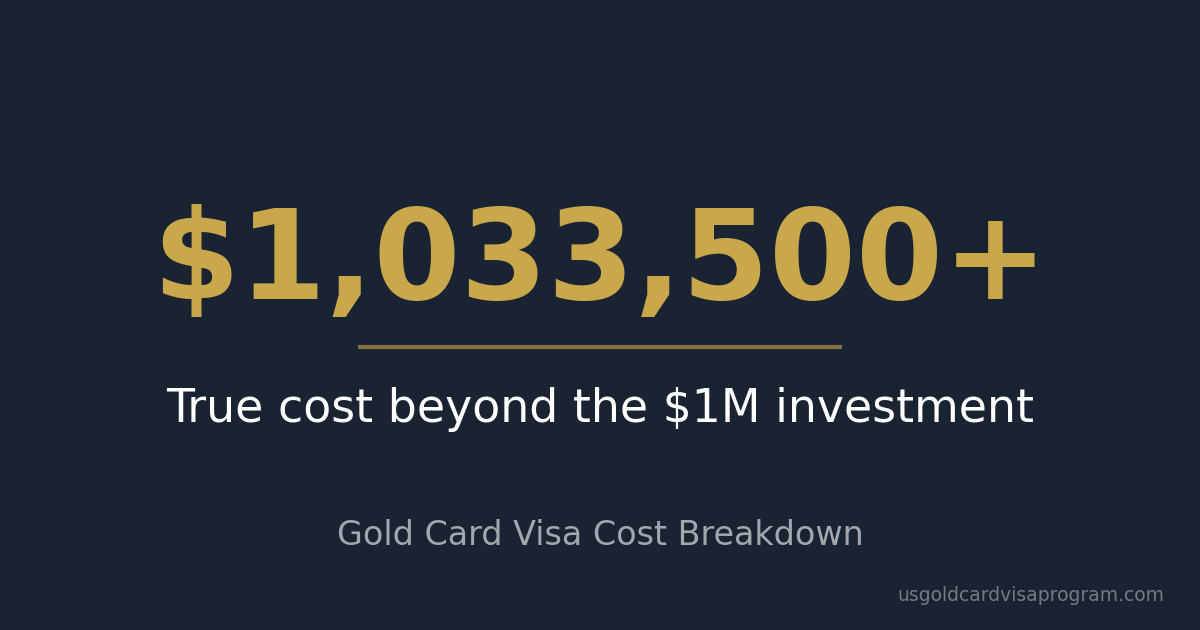
Total Estimated Cost for Individual Gold Card (single applicant): $1,000,000 gift + $15,375 mandatory fee + $31,500–$101,500 in additional costs = approximately $1,047,000–$1,117,000 total.
Total Estimated Cost for Family of 4: $4,000,000 in gifts + $61,500 in mandatory fees + $31,500–$101,500 in additional costs = approximately $4,093,000–$4,163,000 total.
Gold Card vs. EB-5 Visa: Direct Comparison
The most relevant comparison for potential Gold Card applicants is the existing EB-5 Immigrant Investor Program. For a full side-by-side analysis, see our Gold Card vs EB-5 comparison, which has served as America’s primary investment-based immigration pathway for decades. Key distinction: The EB-5 is an investment (capital at risk that may be returned); the Gold Card is a non-refundable gift.
| Factor | Gold Card (Individual) | EB-5 Visa |
| Minimum Amount | $1,000,000 (non-refundable gift) | $800,000 – $1,050,000 (investment) |
| Nature of Payment | Non-refundable gift to Dept. of Commerce | Investment (capital at risk, may be returned) |
| Processing Fee | $15,375 per person (mandatory) | $3,675 filing fee |
| Application Form | I-140G | I-526E |
| TEA Discount | Not applicable | Yes ($800K in qualifying areas) |
| Job Creation Requirement | None | 10 full-time jobs |
| Processing Timeline | Expedited | 2-5 years typically |
| Path to Citizenship | Accelerated | Standard 5-year pathway |
| Family Coverage | Each member needs own $1M gift + $15K fee | Includes spouse + children under 21 |
| Money Back? | No — non-refundable gift | Potentially — capital at risk for 2-5 years |
| Current Status | Active (launched December 2025 at trumpcard.gov) | Active program |
| Annual Quota | Not specified | Limited (approximately 10,000) |
Key Differences Explained
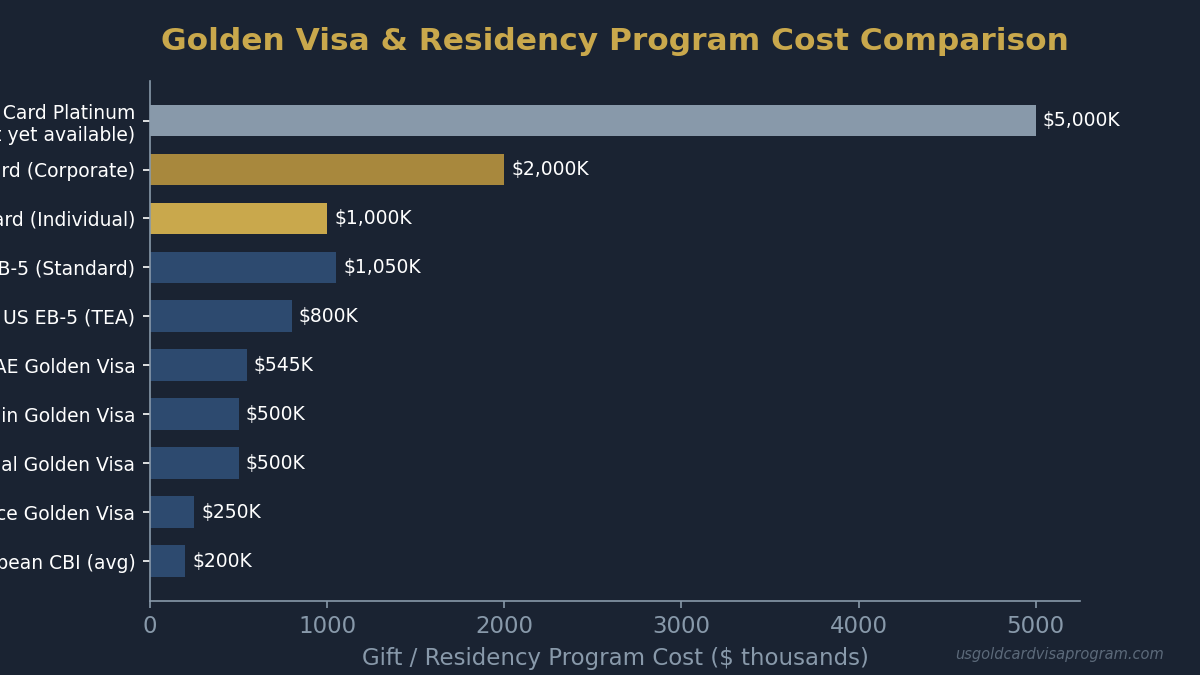
Cost Comparison: The Gold Card’s $1 million gift represents approximately a 1.25x premium over the standard EB-5 investment of $800K. However, the EB-5 investment may be returned after the required period, while the Gold Card gift is non-refundable. For a single applicant, the Gold Card costs modestly more; for a family of four, the Gold Card costs dramatically more ($4M+ vs. $800K–$1.05M for EB-5, which includes family).
Processing Speed: The program emphasizes expedited processing—a significant advantage given EB-5’s notorious backlog, particularly for Chinese, Vietnamese, and Indian applicants facing multi-year wait times.
Job Creation Flexibility: The EB-5 program requires specific job creation metrics tied to the investment. The Gold Card has no job creation requirement since the payment is a gift, not an investment.
Geographic Restrictions: EB-5 offers reduced investment thresholds for projects in Targeted Employment Areas (high-unemployment rural or metropolitan locations). The Gold Card program does not include similar geographic incentives.
Global Golden Visa Programs Comparison
For wealthy individuals considering multiple residency-by-contribution options worldwide, understanding how the Gold Card stacks against established programs is essential.
| Country | Program Name | Minimum Amount | Path to Citizenship | Key Advantages |
| United States | Gold Card (Individual) | $1,000,000 (non-refundable gift) | Accelerated | Access to world’s largest economy, no residency restrictions |
| United States | EB-5 (existing) | $800,000 – $1,050,000 (investment) | 5 years | Established program, TEA discounts, investment may be returned |
| Portugal | Golden Visa | 500,000 (~$540,000) | 5 years | EU residency, minimal physical presence required |
| Spain | Golden Visa | 500,000 (~$540,000) | 10 years | EU access, strong healthcare and education |
| Greece | Golden Visa | 250,000 (~$270,000) | 7 years | Lowest EU threshold, property investment |
| UAE | Golden Visa | AED 10,000,000 (~$2.7M) | 10 years | Tax-free income, strategic business hub |
| Malta | Individual Investor Program | 600,000+ (~$650,000) | 1-3 years | EU citizenship fastest path |
| Cyprus | CIP | 2,000,000+ (~$2.2M) | 3 months | Fastest citizenship in Europe (suspended/under review) |
What the Comparison Reveals
At $1 million for individuals, the Gold Card sits in the mid-to-upper range of global golden visa programs. It is comparable in cost to the EB-5 (a 1.25x premium over the $800K TEA rate), less expensive than the UAE’s $2.7M program, but significantly more than European alternatives. However, the Gold Card payment is a non-refundable gift, while most other programs involve recoverable investments.
The United States offers distinct advantages that may justify the cost for certain applicants (for those who already have extraordinary ability, see our Gold Card vs O-1 visa comparison):
- The world’s largest economy with unmatched market access
- No mandatory physical presence requirements for maintaining residency
- Top-tier educational institutions with preferential access for residents
- Flexible residency allowing holders to live and work anywhere in the U.S.
- Path to citizenship in a country that does not tax citizenship-based income (unlike many nations)
What Does Your Gold Card Contribution Buy?
For those considering the Gold Card, understanding the specific benefits and protections your gift provides is crucial. Remember: this is a non-refundable gift, not an investment.
Program Benefits
Based on the current program framework, Individual Gold Card holders receive:
1. Permanent Residency (Green Card): Full immigration status allowing live, work, and study anywhere in the United States
2. Accelerated Path to Citizenship: Potentially faster naturalization timeline compared to standard 5-year pathways
3. No Sponsorship Requirements: Unlike family-based or employment-based immigration, no U.S. sponsor necessary
4. No Job Creation Requirements: Unlike EB-5, no obligation to create or preserve jobs
5. Access to U.S. Healthcare and Education: Full access to American systems
6. Business Flexibility: Ability to start or invest in businesses without employment restrictions
Important Limitations
- Non-refundable gift: The $1 million payment is a gift to the Department of Commerce and cannot be recovered
- No family inclusion: Each family member needs their own separate $1 million gift + $15,375 fee
- Payment timing: Gift is paid AFTER vetting is complete, not upfront
- Platinum is separate: The $5 million Platinum Card is NOT yet available, is waitlist only, and provides non-immigrant visitor status (not a green card)
Who Can Realistically Afford the Gold Card?
At $1 million per person, the Individual Gold Card is accessible to a much broader pool of applicants than the previously reported $5 million figure. According to global wealth reports, there are approximately 22 million individuals worldwide with $1 million or more in investable assets.
Target Demographic
Based on global wealth distribution, ideal Gold Card candidates typically include (see our full guide on who qualifies for the Gold Card):
- Successful business owners with liquid assets or business valuations exceeding $3–5 million
- Senior professionals in tech, finance, medicine, or law with accumulated savings
- High-net-worth individuals with diversified portfolios of $2+ million in investable assets (since the gift is non-refundable, you need surplus wealth)
- Foreign executives relocating to the U.S. for business expansion
- Individuals from countries with limited visa-free access to the United States who value the certainty of permanent residency
- Family offices seeking U.S. residency for succession planning (note: each family member needs their own $1M gift)
Wealth Threshold Analysis
The $1 million Individual Gold Card is within reach for a significant number of global high-net-worth individuals. However, because the payment is a non-refundable gift (not a recoverable investment), practical considerations include:
- Surplus wealth requirement: You need $1M you can afford to permanently give away
- Family cost multiplier: A family of 4 needs $4M+ in gifts, dramatically narrowing affordability
- Liquidity constraints (most wealth is illiquid—real estate, business equity, or cryptocurrency)
- Existing residency or citizenship alternatives that may be cheaper
- Whether EB-5 ($800K, potentially recoverable) is a better financial decision
Is the Gold Card Worth It? Value Analysis
Determining whether the Gold Card delivers value depends entirely on individual circumstances, goals, and alternatives.
When the Gold Card Makes Sense
The Gold Card may be worth it for applicants who:
- Value time above all else: The expedited processing could save 2-4 years compared to EB-5
- Want simplicity: No job creation requirements, no regional center selection, no business plan
- Require immediate residency: Need U.S. access for business, education, or personal reasons now
- Have exhausted other options: Face long EB-5 backlogs or complex source of funds challenges
- Prioritize American citizenship: Want the ultimate goal of U.S. passport and protection
- Are single applicants: The per-person cost structure favors individual applicants over families
When Alternatives Make More Sense
The Gold Card may not be worth it for applicants who:
- Have families: A family of 4 needs $4M+ in non-refundable gifts vs. $800K–$1.05M total for EB-5 (which includes family members)
- Want their money back: EB-5 investments may be returned after the required period; Gold Card gifts are permanently gone
- Can qualify for EB-5: $800K–$1.05M investments with TEA discounts offer similar residency outcomes with potential capital return
- Don’t need immediate residency: Can wait through standard EB-5 processing times
- Prefer geographic flexibility: Want multiple residency options across several countries
- Seek European access primarily: Portugal, Spain, or Greece offer EU residency at dramatically lower costs
Frequently Asked Questions (FAQ)
For a broader range of questions, visit our comprehensive Gold Card Visa FAQ with 25 questions answered.
How much does the Trump Gold Card visa cost?
The Individual Gold Card requires a $1 million non-refundable gift to the Department of Commerce plus a mandatory $15,375 processing fee ($15,000 + $375) per person. Additional legal and due diligence fees typically add $31,500–$101,500. The Corporate tier is $2 million, and the Platinum tier ($5 million) is not yet available.
Is the Gold Card currently available?
Yes. The Gold Card program launched in December 2025 and is accepting applications at trumpcard.gov using Form I-140G. The Individual ($1M) and Corporate ($2M) tiers are currently live. The Platinum tier ($5M) is not yet available and is waitlist only.
Is the Gold Card payment an investment?
No. The Gold Card payment is a non-refundable gift to the U.S. Department of Commerce. Unlike the EB-5, where your capital is invested in a business and may eventually be returned, the Gold Card gift cannot be recovered. This is a critical distinction applicants must understand.
How does the Gold Card compare to EB-5?
The Individual Gold Card costs $1M (a non-refundable gift) vs. the EB-5’s $800K–$1.05M (a recoverable investment)—a 1.25x premium over the EB-5 TEA rate. The Gold Card offers faster processing and no job creation requirements, but the payment is non-refundable and each family member needs their own $1M gift. EB-5 includes family members in a single application.
Can I get my money back from the Gold Card?
No. The Gold Card payment is a non-refundable gift to the Department of Commerce. The money cannot be recovered or repatriated. This is fundamentally different from the EB-5, where capital is at risk but may be returned after 2-5 years.
Does the Gold Card lead to U.S. citizenship?
Yes, the Individual Gold Card provides permanent residency (green card) with an accelerated path to citizenship compared to standard 5-year naturalization timelines. Note: the Platinum Card ($5M, not yet available) only provides non-immigrant visitor status, NOT a green card or path to citizenship.
Can my family members receive green cards through the Gold Card?
Each family member needs their own separate $1 million gift plus $15,375 processing fee. Unlike the EB-5 program (which includes spouse and children under 21 in a single application), the Gold Card does not offer derivative residency. A family of four would need approximately $4 million+ in gifts. This is one of the most significant cost differences between the Gold Card and EB-5.
What is the Platinum Card?
The Platinum Card is a separate, higher-tier product requiring a $5 million contribution. It is NOT currently available—it is waitlist only and pending Congressional approval. Importantly, the Platinum Card provides non-immigrant visitor status, NOT a green card or permanent residency. Do not confuse it with the Individual Gold Card ($1M), which does provide permanent residency.
Is the Gold Card better than European golden visas?
“Better” depends on your priorities. The U.S. Gold Card offers access to the world’s largest economy and potentially faster citizenship at $1 million (2–4x the cost of European alternatives). European programs offer EU residency at lower levels but without U.S. economic advantages. A key difference: European golden visas typically involve recoverable investments (e.g., property), while the Gold Card is a non-refundable gift.
Conclusion: Is the Gold Card Worth It?
The Trump Gold Card visa represents a bold new approach to American immigration—one that offers a streamlined path to permanent residency through a $1 million non-refundable gift to the Department of Commerce. For single applicants who value speed and simplicity over cost recovery, the Gold Card fills a genuine gap in the market. For families, the per-person cost structure makes the EB-5 potentially far more economical. Before applying, consult a qualified immigration attorney — our immigration attorney guide can help you find the right one and carefully consider whether the non-refundable nature of the gift aligns with your financial goals.
Free Download: The Complete Gold Card Visa Guide 2026
Get our comprehensive PDF guide — Gold Card vs EB-5, qualification checklist, attorney selection guide, and more.
Related: Trump Gold Card Lawsuit: Legal Challenges and Risks for Investors [2026 Updates]
Related: Trump Gold Card Processing Times: What Attorneys Actually Say vs. Government Claims
Compare options: Gold Card Visa vs Portugal Golden Visa: Full Comparison
Tax considerations: Gold Card Visa Tax Implications: What Investors Must Know
Stay Updated on Gold Card Visa Changes
Get real-time updates on policy changes, processing times, and legal developments. Free newsletter, no spam.
This article is for informational purposes only and does not constitute legal or immigration advice. Consult a qualified immigration attorney before making any decisions.
Related Guides
Country-Specific Gold Card Guides
- Gold Card Visa for Indian Citizens — RBI/FEMA rules, INR conversion, backlog bypass
- Gold Card Visa for Chinese Investors — SAFE regulations, capital controls, CNY conversion
- Gold Card Visa for UAE/Gulf Investors — Tax-free to US tax, AED conversion, Golden Visa comparison
- Gold Card Visa for British Citizens — GBP conversion, UK-US tax treaty, dual citizenship
- Gold Card Visa for Nigerian Citizens — CBN restrictions, NGN conversion, scam warnings
About the Editorial Team
This article was researched and written by the editorial team at usgoldcardvisaprogram.com. We specialize in US immigration programs and provide well-researched, regularly updated content. Our information is sourced from official government publications, immigration law firms, and verified policy documents. This content does not constitute legal or financial advice.
Need Help Finding the Right Immigration Attorney?
The Gold Card requires specialized legal expertise. We've put together a guide on what to look for.
Find a Gold Card Attorney →