Trump Gold Card Processing Times: What Attorneys Actually Say vs. Government Claims [2026]
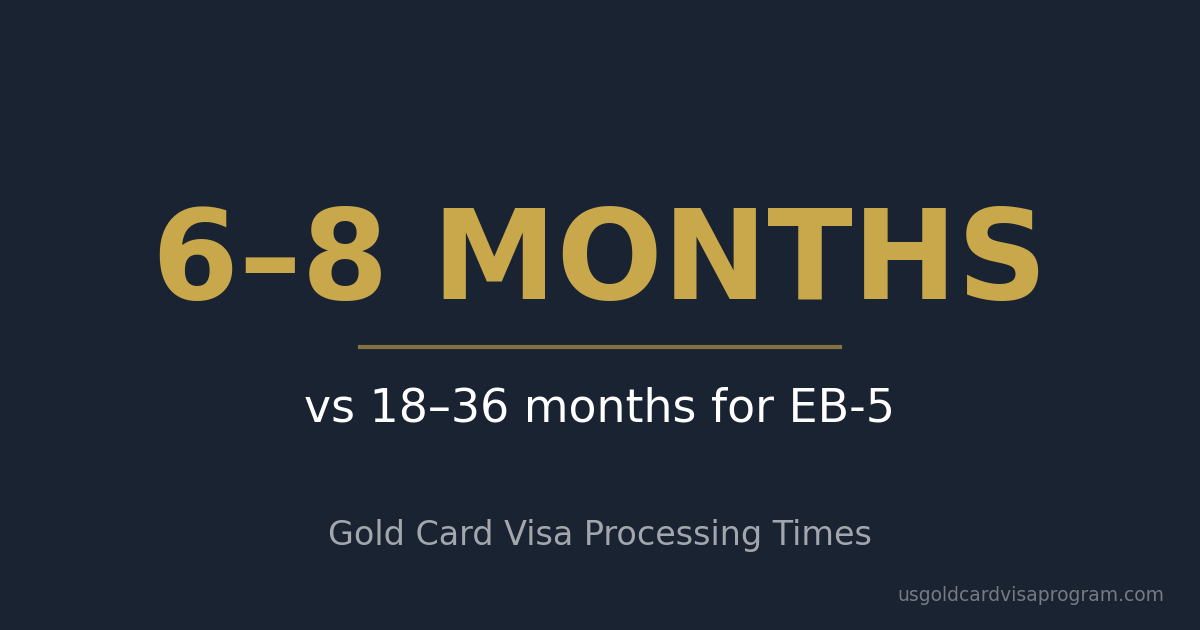
The Trump Gold Card visa program has been live since December 2025. The official website says processing “should take weeks.” Immigration attorneys say the reality is 8 to 18 months — and for applicants from India or China, the wait could stretch to over a decade.
We broke down the Gold Card processing timeline step by step, compared government promises against what attorneys are actually telling their clients, and stacked it up against every alternative investor visa pathway. This is the most detailed processing time analysis available anywhere online.
The Government’s Claim vs. Attorney Reality
Let’s start with the gap between what the government says and what immigration attorneys expect:
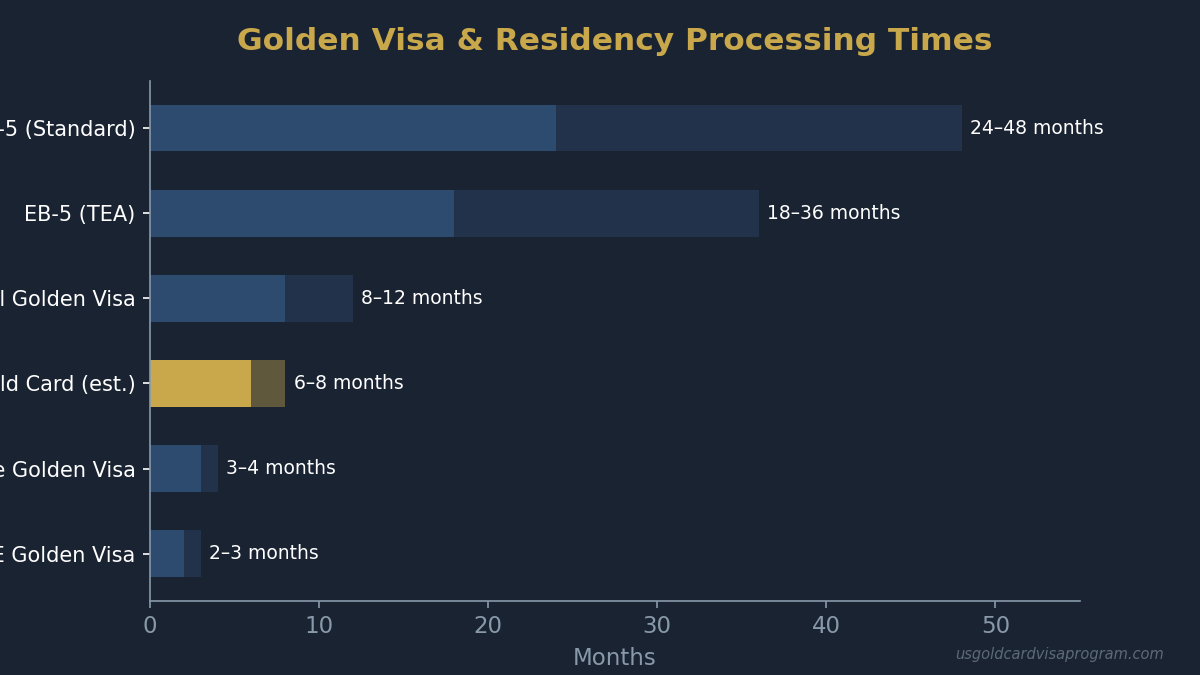 golden visas 2-12 months” width=”1200″ height=”675″ class=”wp-image-254″ srcset=”https://usgoldcardvisaprogram.com/wp-content/uploads/2026/02/visa-processing-time-comparison-1.png 1200w, https://usgoldcardvisaprogram.com/wp-content/uploads/2026/02/visa-processing-time-comparison-1.png 300w, https://usgoldcardvisaprogram.com/wp-content/uploads/2026/02/visa-processing-time-comparison-1.png 1024w, https://usgoldcardvisaprogram.com/wp-content/uploads/2026/02/visa-processing-time-comparison-1.png 768w” sizes=”auto, (max-width: 1200px) 100vw, 1200px” />
| Source | Processing Estimate | What It Actually Covers |
|---|---|---|
| TrumpCard.gov (official) | “Weeks” | Unclear — possibly just initial vetting |
| Harvey Law Corporation | ~12 months standard | Full process, application to green card |
| Shutts & Bowen LLP | 8–18 months | Full process, “assuming no delays” |
| Fragomen LLP | Months for consular processing alone | Final stage only — not including I-140G |
| Gozel Law Firm | “Weeks to a few months” after vetting | Approval stage only, excludes consular |
The key problem: Fragomen, one of the world’s largest immigration law firms, has publicly stated it’s “unclear whether” the government’s “weeks” timeline “refers to the initial application or Form I-140G.” The government has been deliberately vague about which step takes “weeks” — and that vagueness itself is a red flag for applicants committing a $1 million or more non-refundable gift.
The 5 Steps — With Real Time Estimates for Each
The Gold Card process has five distinct stages. The government’s “weeks” claim appears to cover only one of them. Here’s what attorneys estimate for each:
Step 1: Pre-Registration + DHS Fee Payment
What happens: You submit your application on trumpcard.gov and pay the $15,000 non-refundable DHS processing fee per person via pay.gov.
Time estimate: The application itself takes hours to complete. Document preparation — including 5 years of bank statements, 7 years of tax returns, and a 20-year employment history — can take 1–2 months with attorney assistance according to Harvey Law Corporation. An immigration attorney typically needs 15–25 hours of work for proper preparation (visum-usa.com).
Step 2: Government Vetting + Background Screening
What happens: Federal agencies conduct enhanced security screening, source-of-funds verification, financial due diligence, and fraud screening. They may issue Requests for Evidence (RFEs) if documentation is insufficient.
Time estimate: 1–3 months (Shutts & Bowen). This is likely the stage the government means when it says “weeks.” But RFEs can add significant delays — in standard EB-1A cases, an RFE adds 3–6 months to the timeline.
Step 3: I-140G Filing + USCIS Adjudication
What happens: After passing initial vetting, USCIS notifies you to file Form I-140G electronically through myUSCIS. This is the formal immigrant petition that determines your eligibility under EB-1 or EB-2 categories.
Time estimate:
- Standard processing: Up to 12 months (Harvey Law)
- Premium processing: 2–4 months (Harvey Law estimate); for comparison, standard EB-1A premium processing takes 15 business days and EB-2 NIW takes 45 business days
Critical detail: If USCIS issues an RFE during this stage, the premium processing clock stops and resets completely upon your response. One RFE can turn a 3-week premium timeline into a 4-month wait.
Step 4: Gift Payment to U.S. Treasury
What happens: Upon conditional approval, you transfer your $1 million (individual) or $2 million (corporate) to the U.S. Treasury via ACH or SWIFT wire transfer. This is a non-refundable, unconditional gift — not an investment.
Time estimate: The wire itself takes days. But documenting the source of funds to the government’s satisfaction may have already consumed weeks during vetting. Post-vetting approval and payment processing takes several weeks to a few months (Shutts & Bowen, Gozel Law).
Step 5: Consular Processing or Adjustment of Status
What happens: This is the final step to actually get your green card. If you’re outside the U.S., you complete Form DS-260G and attend an interview at a U.S. embassy or consulate. If you’re already in the U.S. on an eligible visa, you file Form I-485 (Adjustment of Status).
Time estimate:
- Consular processing: 2–8 months depending on the embassy’s workload (Fragomen says “several months”; Shutts estimates 4–8 months; Harvey Law estimates 2–4 months)
- Adjustment of Status (if in U.S.): 6–12 months (Shutts & Bowen)
Free Gold Card Visa Guide
Get our Gold Card guide with cost breakdowns, timelines, and attorney tips. Delivered instantly to your inbox.
No spam. Unsubscribe anytime.
The Total Timeline: Best Case to Worst Case
| Scenario | Estimated Timeline | Conditions |
|---|---|---|
| Best case | 6–8 months | Premium processing, no RFEs, no visa backlog, fast consulate |
| Typical case | 8–14 months | Standard processing, no major issues, most countries |
| With complications | 14–24 months | RFEs, slow consulate, litigation delays |
| India (EB-2 classification) | 12+ years | Subject to EB-2 India visa backlog |
| China (EB-2 classification) | 4+ years | Subject to EB-2 China visa backlog |
Shutts & Bowen emphasizes their 8–18 month estimate assumes “no litigation delays, requests for evidence, or adverse policy changes.” Given that the program is currently facing a major federal lawsuit, that assumption is not guaranteed.
The India and China Backlog: The Detail Nobody Talks About
This is the single most important fact that most Gold Card coverage ignores: the Gold Card does not create a new visa category. It uses existing EB-1 and EB-2 visa slots.
That means Gold Card applicants are subject to the same per-country caps and visa backlogs as every other employment-based applicant. Here’s what the January 2026 Visa Bulletin shows:
| Category | Most Countries | India | China |
|---|---|---|---|
| EB-1 | Current (no wait) | ~3+ year backlog | ~2+ year backlog |
| EB-2 (Final Action Date) | April 2024 | July 2013 | September 2021 |
Read those dates carefully. The EB-2 Final Action Date for India is July 2013. That means if you’re an Indian national classified under EB-2, your $1 million Gold Card payment gets you into the same queue as someone who filed in 2013 — and you’ll wait behind them. The estimated backlog for Indian EB-2 applicants is approximately 12.4 years.
The trumpcard.gov website acknowledges this only with the understatement: “A small number of countries may have wait times of up to a year or more based on visa availability.”
“A year or more” for a 12-year wait is a significant understatement.
Why This Matters for Your EB Classification
Your processing time depends entirely on whether USCIS classifies your petition as EB-1 or EB-2:
- EB-1 (Extraordinary Ability): Shorter backlogs, but higher qualification standards. You need to demonstrate sustained national or international acclaim.
- EB-2 (Exceptional Ability / NIW): Longer backlogs, especially for India and China. Lower qualification threshold than EB-1, but the visa queue is dramatically longer.
There is a contested legal question about whether the Gold Card payment itself qualifies as sufficient evidence for EB-1/EB-2 eligibility. Some attorneys (Alston & Bird) interpret the executive order as treating the donation as the qualifying factor. Others (Harvey Law) explicitly state that “USCIS still denies for not meeting EB-1A/EB-2 NIW standards” — meaning your million-dollar payment doesn’t automatically mean approval.
Gold Card vs. Every Alternative: Side-by-Side Processing Comparison
| Program | Best Case | Typical | India/China | Min. Cost |
|---|---|---|---|---|
| Gold Card | 6–8 months | 8–14 months | 4–12+ years | $1.015M/person |
| EB-5 Rural TEA | Under 1 year | 12–18 months | Current (no backlog) | ~$900K/family |
| EB-5 Standard | 15–24 months | 2–5 years | 5–7+ years | $1.05M/family |
| EB-1A (merit) | 8 months | 8–18 months | 3+ years (India) | ~$5K fees |
| EB-2 NIW (merit) | 18 months | 2–3 years | 12+ years (India) | ~$5K fees |
Two things stand out from this comparison:
- EB-5 Rural TEA has no country-specific backlog — making it potentially faster than the Gold Card for Indian and Chinese applicants, at a lower cost, and the investment may be returned after 5–7 years. The Gold Card payment is gone forever.
- EB-1A costs a fraction of the Gold Card and has comparable processing times for applicants who genuinely qualify. If you have the credentials, the Gold Card’s million-dollar payment buys you almost nothing in terms of speed.
For a deeper dive on the EB-5 comparison, read our Gold Card vs. EB-5: Which is Better in 2026? analysis.
Premium Processing: What It Actually Does (and Doesn’t Do)
Premium processing is available for the I-140G petition stage. Here’s what attorneys want you to understand:
What premium processing does:
- Accelerates the USCIS petition decision (I-140G stage only)
- Standard EB-1A premium takes 15 business days; EB-2 NIW takes 45 business days
- Harvey Law estimates 2–4 months for Gold Card premium processing
What premium processing does NOT do:
- Does not change your priority date
- Does not advance your position in the Visa Bulletin queue
- Does not speed up consular processing or adjustment of status
- Does not exempt you from per-country caps
- Does not help with India/China backlogs at all
For Indian EB-2 applicants, paying for premium processing means getting your petition approved faster — and then waiting 12+ years in the same queue as everyone else. Premium processing does not solve the fundamental bottleneck.
The 70,000-Applicant Queue Problem
Commerce Secretary Howard Lutnick announced approximately 70,000 people had joined the Gold Card waitlist, with 80,000 cards initially being made available. But these applicants are competing for existing EB-1 and EB-2 visa numbers.
The combined annual allocation for EB-1 and EB-2 categories is approximately 80,000 visas — but that allocation serves all employment-based applicants, not just Gold Card holders. Standard EB-1A petitioners, EB-2 NIW filers, and employer-sponsored immigrants all draw from the same pool.
If even a fraction of those 70,000 Gold Card applicants file and are approved, they could significantly increase backlogs for everyone in the EB-1 and EB-2 queues — including for other Gold Card applicants.
Common Causes of Delays and Denials
Based on attorney guidance and USCIS patterns with similar petition types, here’s what causes Gold Card processing delays:
- Weak source-of-funds documentation: The government requires 5 years of bank statements and 7 years of tax returns. Gaps or inconsistencies trigger RFEs.
- Incomplete employment history: You must document 20 years of employment. Unexplained gaps are flagged.
- EB-1/EB-2 qualification disputes: If USCIS determines you don’t meet the underlying visa category standards, your petition can be denied — even after paying $1 million.
- Requests for Evidence (RFEs): Each RFE can add 3–6 months. In standard EB-1A premium processing, an RFE stops and resets the entire premium clock.
- Consular post workload: Interview wait times vary wildly by embassy. Some posts schedule within weeks; others take 6+ months.
- Active litigation: The federal lawsuit against the program could result in processing delays or an injunction freezing all applications.
What “Zero Verified Holders” Means for Processing Estimates
Every processing time estimate in this article is based on attorney projections and comparisons with existing EB categories. As of February 2026, there are zero publicly verified cases of anyone completing the Gold Card process. No approval statistics have been released by the government. No immigration attorney has publicly reported a confirmed Gold Card green card.
This means the actual processing times could be faster or slower than current estimates. We simply don’t know yet — and anyone claiming certainty is speculating.
We’ll update this article as the first confirmed approvals (or denials) are reported.
Get Processing Time Updates as They Happen
We’re tracking Gold Card processing times, approval data, and policy changes in real time. Get updates delivered to your inbox — free, no spam.
Frequently Asked Questions
How long does it actually take to get a Trump Gold Card?
Attorney estimates range from 6–8 months (best case with premium processing) to 8–14 months (typical) to 12+ years for Indian nationals classified under EB-2. The government’s “weeks” claim covers only the initial vetting stage, not the full process. See our step-by-step application guide for the complete process.
Does premium processing speed up the entire Gold Card process?
No. Premium processing only accelerates the I-140G petition stage. It does not affect consular processing times, visa backlog queues, or per-country caps. For applicants from India or China facing multi-year backlogs, premium processing makes almost no difference to total wait time.
Is the Gold Card faster than EB-5?
It depends on your country of origin. For most nationalities, the Gold Card may be comparable or slightly faster than standard EB-5. But EB-5 Rural TEA investments currently have no country-specific backlog, making them potentially much faster for Indian and Chinese applicants — at a lower cost with the possibility of getting your investment back.
Why hasn’t anyone received a Gold Card yet?
The program portal launched in December 2025, making it less than 3 months old as of February 2026. Even the most optimistic processing estimates suggest 6+ months, so the first confirmed approvals aren’t expected until mid-2026 at the earliest. The active federal lawsuit may also be causing processing caution within agencies.
Can my Gold Card application be denied after I pay $1 million?
Yes. According to Harvey Law Corporation, “USCIS still denies for not meeting EB-1A/EB-2 NIW standards.” The payment is non-refundable regardless of outcome. We strongly recommend consulting a qualified immigration attorney to assess your eligibility before applying.
What are the processing fees beyond the $1 million gift?
Each person pays a $15,000 non-refundable DHS processing fee. A family of four would owe approximately $4.06 million total ($1M gift + $15K fee per person). For a complete cost breakdown, see our Gold Card cost analysis.
This article is for informational purposes only and does not constitute legal or immigration advice. Processing times are estimates based on attorney projections and may vary significantly. Consult a qualified immigration attorney before making any decisions.
Related: Gold Card Tax Implications | Gold Card for Crypto Entrepreneurs
About the Editorial Team
This article was researched and written by the editorial team at usgoldcardvisaprogram.com. We specialize in US immigration investment programs and provide well-researched, regularly updated content. Our information is sourced from official government publications, immigration law firms, and verified policy documents. This content does not constitute legal or financial advice.
Need Help Finding the Right Immigration Attorney?
The Gold Card requires specialized legal expertise. We've put together a guide on what to look for.
Find a Gold Card Attorney →