
Gold Card Visa Source of Funds: How to Document Your Gift Payment
Why Source of Funds Documentation Is Critical
When a visa program requires a non-refundable gift payment of $1 million (individual Gold Card) plus a $15,000 processing fee, the scrutiny applied to the origin of those funds is among the most intensive in all of immigration law. Source of funds documentation is not a formality — it is the backbone of any Gold Card Visa application. The application is filed using Form I-140G under the EB-1A or EB-2 NIW visa categories. Adjudicators must verify that every dollar of the required gift payment was lawfully earned, acquired, or accumulated. Failure to provide clear, verifiable documentation is one of the most common reasons high-value immigration petitions are delayed, questioned, or denied outright.
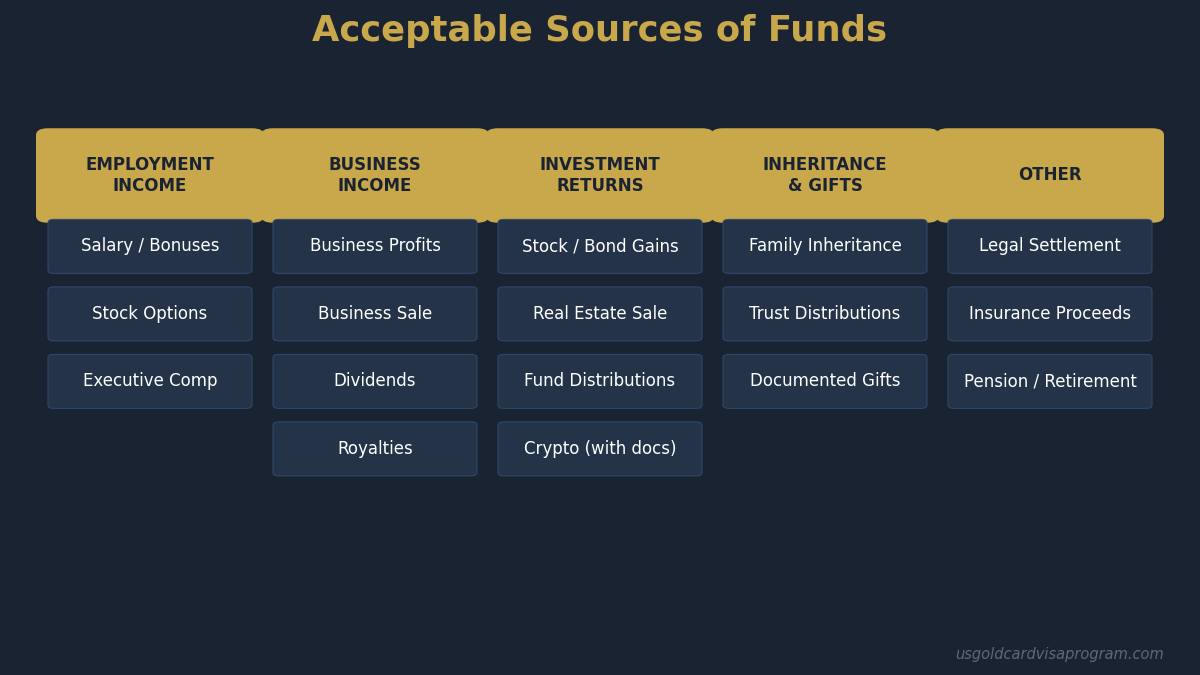
The purpose of source of funds review is threefold. First, it protects the integrity of the program by ensuring that gift payment capital does not originate from illicit activities such as money laundering, fraud, or corruption. Second, it satisfies anti-money-laundering (AML) and know-your-customer (KYC) obligations that the US government applies to large financial transactions. Third, it demonstrates to adjudicators that the applicant has a legitimate financial profile consistent with someone capable of committing the required gift payment amount.
Applicants who underestimate the importance of source of funds preparation often face Requests for Evidence (RFEs) that can add months or even years to the timeline. A well-prepared documentation package, assembled proactively with the help of qualified professionals, significantly reduces the likelihood of delays and demonstrates the seriousness and credibility of the applicant from the outset.
Given the scale of the Gold Card Visa investment — substantially larger than the EB-5 program’s minimum threshold — it is reasonable to expect that source of funds reviews will be correspondingly thorough. Applicants should plan to invest significant time and professional resources into building a documentation package that leaves no ambiguity about the lawful origin of every component of their Gold Card gift payment.
What Qualifies as a Legitimate Source of Funds
Understanding which categories of funds are generally considered legitimate is the first step in preparing your documentation. The following sources are widely recognized in US immigration law as lawful origins for investment capital.
Business Income and Profits
Revenue generated through lawful business operations is one of the most common sources of gift payment capital for high-net-worth individuals. This includes profits from companies you own or in which you hold a significant stake, distributions from partnerships or limited liability companies, and retained earnings that have been accumulated over the life of a business. Applicants relying on business income should be prepared to demonstrate the legitimacy of the business itself, its financial performance over a sustained period, and the path by which profits flowed from the business to the applicant’s personal accounts.
Investment Returns and Capital Gains
Profits earned from stocks, bonds, mutual funds, private equity, venture capital, cryptocurrency, and other financial instruments can serve as a legitimate source of funds. Documentation should trace the original capital, the growth or returns achieved, and the liquidation or withdrawal of those gains into accounts from which the Gold Card Visa gift payment will be made. Note that all cryptocurrency holdings must be documented with blockchain-traceable records as part of the I-140G requirements. For applicants with complex investment portfolios, brokerage statements, trade confirmations, and capital gains tax filings will be essential.
Real Estate Sales Proceeds
The sale of real property — whether residential, commercial, or land — is a straightforward source of gift payment capital, provided the applicant can document the original purchase, the holding period, and the sale itself. Closing statements, title transfers, mortgage payoff records, and proof of deposit of the sale proceeds all contribute to a clear paper trail. If the property was acquired through inheritance or gift, additional documentation of that original transfer will also be required.
Inheritance and Gifts
Funds received through inheritance or as a bona fide gift from a family member or other individual can qualify as a legitimate source of funds for the gift payment. However, the documentation burden is significant. Applicants must typically provide the will or probate records, death certificate of the decedent, tax filings related to the inheritance, and evidence that the inherited funds were lawfully earned by the original owner. For gifts, a signed gift letter or affidavit, evidence of the donor’s ability to make the gift, and any applicable gift tax documentation are generally required.
Salary and Employment Income Over Time
High-net-worth individuals who have accumulated wealth through executive compensation, bonuses, stock options, or long-term employment income can use these funds for their gift payment. The key challenge is demonstrating that the accumulated savings over many years are sufficient and that the trail from paycheck to savings to the gift payment account is clear and documented. Employment contracts, pay stubs, W-2 equivalents from foreign jurisdictions, and bank statements showing deposits over time will form the foundation of this documentation.
Liquidation of Existing Assets
Some applicants may need to liquidate a combination of assets — such as stock portfolios, real estate holdings, business interests, or valuable personal property — to assemble the required gift payment amount. In such cases, each asset must be independently documented, including how it was originally acquired, its value at the time of liquidation, and the proceeds received. Appraisals, sales receipts, and transfer records are essential components of this documentation.
Free Gold Card Visa Guide
Get our Gold Card guide with cost breakdowns, timelines, and attorney tips. Delivered instantly to your inbox.
No spam. Unsubscribe anytime.
Documentation Requirements — What You Need to Gather
Assembling a complete source of funds package requires gathering a wide range of financial documents. The following categories represent the core documentation that applicants should anticipate needing. All documents from foreign jurisdictions should be accompanied by certified English translations.
Bank Statements
Comprehensive bank statements from all relevant accounts — personal, business, and investment — are the foundation of any source of funds package. Expect to provide at least three to five years of statements from every account involved in the accumulation or transfer of the investment funds. Statements should show regular deposits consistent with the claimed income sources and a clear trail from the earning of funds to their availability for the gift payment. Gaps in the record or unexplained large deposits will almost certainly trigger additional questions from adjudicators.
Tax Returns
Personal and business tax returns — both from the applicant’s home country and from any jurisdiction where the applicant has tax obligations — provide independent verification of income. Tax returns corroborate the income figures shown in bank statements and business records. Applicants should plan to provide at least five years of returns, and in some cases, adjudicators may request additional years to verify the long-term accumulation of wealth. If the applicant’s home country does not have an income tax system, alternative documentation of income verification should be discussed with a qualified immigration attorney.
Business Financial Statements
For applicants whose investment funds derive from business profits, audited financial statements of the relevant businesses are critical. These include balance sheets, income statements, cash flow statements, and any auditor’s reports. Ideally, these should be prepared in accordance with internationally recognized accounting standards (such as IFRS or US GAAP) and audited by a reputable accounting firm. Unaudited financials may be accepted but carry less weight and may invite additional scrutiny.
Property Sale Records
If real estate sales contribute to the investment funds, applicants should gather original purchase contracts, closing statements from both the purchase and sale, title documents, mortgage records, and proof of deposit of the sale proceeds into an identifiable account. Property valuations or appraisals at the time of purchase and sale can also strengthen the documentation by confirming the reasonableness of the transaction amounts.
Investment Account Statements
Brokerage statements, fund prospectuses, trade confirmations, and year-end account summaries document investment returns and capital gains. These records should show the original investment, any contributions or withdrawals over time, and the growth that resulted in the funds available for the Gold Card Visa gift payment. Statements from custodial accounts, retirement accounts (if applicable), and alternative investment vehicles like private equity or hedge funds should also be included.
Inheritance Documentation
When inheritance forms part or all of the source of funds, the following documents are typically required: the last will and testament of the decedent, a death certificate, probate court records, any applicable estate or inheritance tax filings, and evidence of the transfer of funds from the estate to the applicant. If the inheritance was received in a foreign jurisdiction, additional documentation establishing the legitimacy of the decedent’s wealth may be necessary.
Gift Documentation and Affidavits
For gifted funds, a detailed gift letter signed by the donor is essential. The letter should state the donor’s relationship to the applicant, the amount of the gift, the date of the gift, and an affirmation that no repayment is expected. Additionally, the donor should provide documentation of their own ability to make the gift, including bank statements and evidence of the lawful source of the gifted funds. Depending on the jurisdiction, gift tax returns or declarations may also be required.
Common Source of Funds Challenges
Even applicants with entirely legitimate wealth face documentation challenges that can complicate their Gold Card Visa applications. Anticipating these challenges and addressing them proactively is essential.
Funds from Multiple Sources
Many high-net-worth individuals accumulate wealth from a combination of business income, investment returns, real estate, and other sources. When the gift payment is assembled from multiple streams, each source must be independently documented and traced to the gift payment account. The challenge is creating a coherent narrative that ties all these streams together into a single, clear picture. A detailed source of funds chart — mapping each source, its amount, and the supporting documentation — can be invaluable in these situations.
Funds in Multiple Currencies
Applicants who hold wealth in multiple currencies face the additional complexity of documenting foreign exchange conversions. Every conversion from a foreign currency to US dollars (or the currency of the gift payment) should be documented with bank records showing the exchange rate applied, the date of the conversion, and the amounts before and after the exchange. Currency conversion records from banks or licensed foreign exchange providers are the preferred form of documentation. Informal or undocumented conversions — particularly in jurisdictions with currency controls — can create significant issues.
Funds Held in Trusts or Corporate Structures
Wealth held through trusts, holding companies, family offices, or other corporate structures adds layers of complexity to source of funds documentation. Adjudicators will want to see through the corporate veil to the ultimate beneficial owner and the original source of the funds. Trust deeds, corporate formation documents, shareholder agreements, audited financial statements of the entities, and evidence of the applicant’s beneficial ownership or control over the funds will all be necessary. Applicants with complex structures should work closely with both legal and accounting professionals to prepare this documentation.
Funds from Countries with Limited Banking Transparency
Some applicants come from jurisdictions where banking systems are less formal, record-keeping standards differ from Western norms, or financial institutions do not readily provide the type of detailed statements that US adjudicators expect. In these cases, applicants may need to supplement bank records with alternative forms of verification — such as sworn affidavits from bank officers, government-issued tax assessments, or third-party audit reports. Working with local counsel who understands both the home country’s financial system and US documentation expectations is particularly important for applicants in this situation.
Co-mingled Personal and Business Funds
In many parts of the world, entrepreneurs and business owners do not maintain strict separation between personal and business finances. When personal and business funds are co-mingled in the same accounts, tracing the source of investment capital becomes significantly more difficult. Applicants in this position should work with a CPA or auditor to reconstruct the flow of funds and create a clear accounting that separates business income from personal expenditures and identifies the specific funds earmarked for the Gold Card Visa gift payment. The earlier this separation and documentation process begins, the stronger the application will be.
Building Your Documentation Package
A strong source of funds package is more than a collection of bank statements and tax returns. It is a structured, narrative-driven submission that tells the story of the applicant’s wealth accumulation in a way that adjudicators can easily follow and verify.
Creating a Clear Paper Trail
The concept of a paper trail is central to source of funds documentation. Every dollar of the Gold Card gift payment should be traceable from its original source — whether that is a business profit, a salary payment, an investment return, or a property sale — through any intermediate accounts or transfers, to the final gift payment account. The paper trail should be continuous, with no unexplained gaps or jumps. If funds pass through multiple accounts or entities before reaching the investment account, each transfer must be documented with corresponding records from both the sending and receiving institutions.
Timeline of Fund Accumulation
Preparing a clear timeline that shows when and how the gift payment funds were accumulated is a powerful organizational tool. This timeline should list each major source of funds, the approximate date or period during which those funds were earned or received, and the supporting documentation for each entry. A well-constructed timeline not only helps the adjudicator understand the applicant’s financial history but also serves as a roadmap for the entire documentation package. It demonstrates that the applicant has taken a systematic, transparent approach to documenting their wealth.
Third-Party Verification Letters
Letters from banks, employers, business partners, accountants, and other third parties can provide independent corroboration of the applicant’s financial claims. A letter from a bank officer confirming account balances and transaction history, a letter from an employer confirming compensation, or a letter from an accountant confirming the financial performance of a business all add credibility to the application. These letters should be on official letterhead, signed by an authorized representative, and as specific as possible regarding amounts, dates, and the nature of the financial relationship.
Certified Translations for Foreign Documents
All documents submitted in a language other than English must be accompanied by a certified English translation. The translation should be performed by a qualified translator who attests to the accuracy and completeness of the translation. Machine translations or informal translations are generally not acceptable. For applicants with large volumes of foreign-language documents, the translation process can be time-consuming and costly, so it should be factored into the overall preparation timeline. Working with a translation service that has experience with financial and legal documents is strongly recommended to ensure accuracy and consistency across the entire package.
Lessons from EB-5 Source of Funds Reviews
While the Gold Card Visa program is distinct from the EB-5 Immigrant Investor Program, the EB-5 program’s decades of adjudication history provides valuable insights into how source of funds reviews are likely to be conducted.
What EB-5 Precedent Tells Us About Scrutiny Levels
The EB-5 program, which requires a minimum investment of $800,000 to $1,050,000 depending on the project location, subjects applicants to rigorous source of funds reviews. US Citizenship and Immigration Services (USCIS) examiners are trained to look beyond the face of documents and probe for inconsistencies, gaps, and red flags. Given that the Gold Card Visa requires a gift payment significantly larger than the EB-5 minimum ($1 million for the individual Gold Card, with a future Platinum tier at $5 million pending Congressional approval), it is reasonable to expect that adjudicators will apply at least the same level of scrutiny — and potentially more. The stakes are higher for both the applicant and the government, which means that thorough preparation is even more essential.
Common Rejection Reasons
Analysis of EB-5 adjudication trends reveals several recurring reasons for denial or delay related to source of funds. Incomplete documentation — particularly missing years of bank statements or tax returns — is the most common issue. Unexplained large deposits or transfers that do not correspond to documented income sources are another frequent problem. Inconsistencies between claimed income and tax filings, or between business financial statements and personal bank deposits, raise red flags that can be difficult to resolve once identified by an examiner. Reliance on loans without documenting the collateral and the source of the collateral’s value is also a well-known pitfall. Applicants who learn from these EB-5 precedents can avoid many of the same mistakes in their Gold Card Visa applications.
How Gold Card May Differ
While EB-5 precedent is instructive, the Gold Card Visa program may introduce its own unique requirements and adjudication standards. The non-refundable nature of the gift payment, the higher dollar threshold, and the specific legislative framework of the program could all influence how source of funds reviews are structured. It is possible that the program will implement streamlined review procedures for applicants from certain jurisdictions or with certain types of documentation. Conversely, the program may impose additional requirements not found in the EB-5 context. Until final regulations are published, applicants should prepare for a level of scrutiny at least equal to — and potentially exceeding — what EB-5 applicants face. Consulting with an immigration attorney who is tracking the regulatory development of the Gold Card Visa program is strongly advisable.
Working with Your Professional Team
Given the complexity and high stakes of source of funds documentation for an investment of this magnitude, assembling and working with a team of qualified professionals is not optional — it is essential. Each member of the team plays a distinct and important role.
Role of Attorney in SOF Preparation
An experienced immigration attorney — ideally one with specific expertise in investor visa programs — serves as the quarterback of the source of funds preparation process. The attorney identifies what documentation is needed based on the applicant’s specific financial profile, reviews all documents for completeness and consistency, crafts the legal arguments and narrative that frame the source of funds submission, and responds to any Requests for Evidence (RFEs) from adjudicators. The attorney should be involved from the earliest stages of preparation, as their guidance can shape the strategy for how funds are organized, transferred, and documented. Choosing an attorney with a strong track record in EB-5 source of funds cases is particularly valuable, as many of the same principles and skills will apply. Attorneys should be familiar with the I-140G form and its specific documentation requirements.
Role of CPA or Auditor
A certified public accountant (CPA) or independent auditor provides the financial expertise needed to organize, verify, and present the applicant’s financial records. For applicants with business income, the CPA can prepare or review financial statements, reconcile business and personal accounts, and create schedules that map the flow of funds from their source to the gift payment account. For applicants with complex tax situations — particularly those with income from multiple countries — the CPA can ensure that all relevant tax filings are gathered and that the reported income is consistent with the claimed source of funds. An independent audit letter from a reputable accounting firm can significantly strengthen the application.
Role of Banking Officer
A relationship manager or banking officer at the applicant’s primary financial institution can provide verification letters, historical account statements, and explanations of banking practices in the applicant’s home country. In some cases, the banking officer can facilitate the transfer of funds in a manner that creates a clean, well-documented paper trail. Applicants should establish a good working relationship with their bank early in the process, as retrieving historical records can take time and may require special requests. For applicants with accounts at multiple institutions, coordinating with banking officers at each institution is important to ensure that the entire flow of funds is documented consistently.
Preparation Checklist and Timeline
Thorough preparation for source of funds documentation is a process that should begin well in advance of filing a Gold Card Visa application. The following checklist and suggested timeline can help applicants organize their efforts systematically.
- 12+ months before filing: Engage an immigration attorney experienced in investor visa programs. Conduct an initial consultation to assess your financial profile and identify potential documentation challenges. Begin separating co-mingled personal and business funds if applicable.
- 9–12 months before filing: Engage a CPA or auditor to begin reviewing and organizing financial records. Request historical bank statements (minimum five years) from all relevant financial institutions. Gather personal and business tax returns for the most recent five or more years.
- 6–9 months before filing: Compile business financial statements, property records, investment account statements, and any inheritance or gift documentation. Request third-party verification letters from banks, employers, and other relevant institutions. Begin certified translations of all foreign-language documents.
- 3–6 months before filing: Work with your attorney and CPA to construct the source of funds narrative and timeline chart. Review all documentation for completeness, consistency, and gaps. Address any identified weaknesses by gathering supplemental records or affidavits. Finalize the organization of the documentation package.
- 1–3 months before filing: Conduct a final review of the complete source of funds package with your attorney. Ensure that all documents are properly organized, indexed, and labeled. Confirm that certified translations are complete and accurate. Prepare a cover letter and source of funds summary memorandum.
- At filing: Submit the complete source of funds documentation as part of your Gold Card Visa application. Retain copies of everything submitted. Be prepared to respond promptly to any follow-up requests from adjudicators.
Starting early is one of the most important factors in a successful source of funds submission. Many of the most difficult challenges — retrieving old records, obtaining third-party letters, resolving co-mingling issues — take time to address. Applicants who begin the process well in advance are in a much stronger position than those who rush to assemble documentation at the last minute.
Key Takeaways
Source of funds documentation is arguably the most critical and demanding component of a Gold Card Visa application. The Gold Card gift payment threshold ($1 million for individuals plus a $15,000 processing fee, $2 million for Corporate, and $5 million for Platinum pending Congressional approval) means that adjudicators will scrutinize the origin of funds with exceptional care. The I-140G application requires a 20-year employment history, complete education history, all government and military positions held, and full disclosure of all financial accounts including cryptocurrency wallets with blockchain-traceable records. The $1 million gift payment is made to the Department of Commerce after the vetting process is complete. Applicants must be prepared to demonstrate, with clear and verifiable documentation, that every dollar of their gift payment was lawfully earned or acquired.
The range of acceptable fund sources is broad — from business profits and investment income to real estate sales, inheritance, employment income, and asset liquidation — but each source carries its own documentation requirements. Assembling a comprehensive package requires gathering years of bank statements, tax returns, financial statements, property records, and third-party verification letters, all supported by certified translations where necessary.
Common challenges include funds from multiple sources, multiple currencies, complex trust or corporate structures, limited banking transparency in certain jurisdictions, and co-mingled personal and business accounts. Each of these challenges can be overcome with proper planning and professional guidance, but they must be identified and addressed early in the preparation process.
Lessons from the EB-5 program’s adjudication history suggest that incomplete documentation, unexplained deposits, and inconsistencies between financial records are the most common reasons for delays and denials. The Gold Card Visa program, with its significantly higher gift payment requirement, is likely to apply at least an equivalent level of scrutiny.
Building a strong source of funds package is a team effort. An experienced immigration attorney, a qualified CPA or auditor, and a cooperative banking officer each play essential roles. The process should begin at least twelve months before the planned filing date to allow adequate time for document gathering, organization, and review.
Now that the Gold Card Visa program is live at trumpcard.gov, applicants should begin their source of funds preparation as soon as possible. Those who act decisively — engaging professionals, organizing records, and building a clear paper trail — will be best positioned to submit strong, complete applications without delay. Always consult with qualified immigration and financial professionals for guidance tailored to your specific circumstances.
Related: How to Apply for the Gold Card | Gold Card vs Portugal Golden Visa | Gold Card Visa FAQ | Gold Card Lawsuit and Legal Risks
📋 Free Download: The Complete Gold Card Visa Guide 2026
Get our comprehensive PDF guide — Gold Card vs EB-5, qualification checklist, attorney selection guide, and more.
No spam. Unsubscribe anytime.
Related: US Gold Card Visa Tax Implications for Investors
Stay Updated on Gold Card Visa Changes
Get real-time updates on policy changes, processing times, and legal developments. Free newsletter, no spam.
About the Editorial Team
This article was researched and written by the editorial team at usgoldcardvisaprogram.com. We specialize in US immigration investment programs and provide well-researched, regularly updated content. Our information is sourced from official government publications, immigration law firms, and verified policy documents. This content does not constitute legal or financial advice.
Need Help Finding the Right Immigration Attorney?
The Gold Card requires specialized legal expertise. We've put together a guide on what to look for.
Find a Gold Card Attorney →