Trump Gold Card vs EB-5 Visa: Which is Better in 2026?
For high-net-worth individuals seeking U.S. permanent residency, two pathways dominate the conversation in 2026: the Trump Gold Card and the traditional EB-5 Immigrant Investor Program. Both offer routes to a green card, but the differences in cost, requirements, processing time, and structure are substantial.
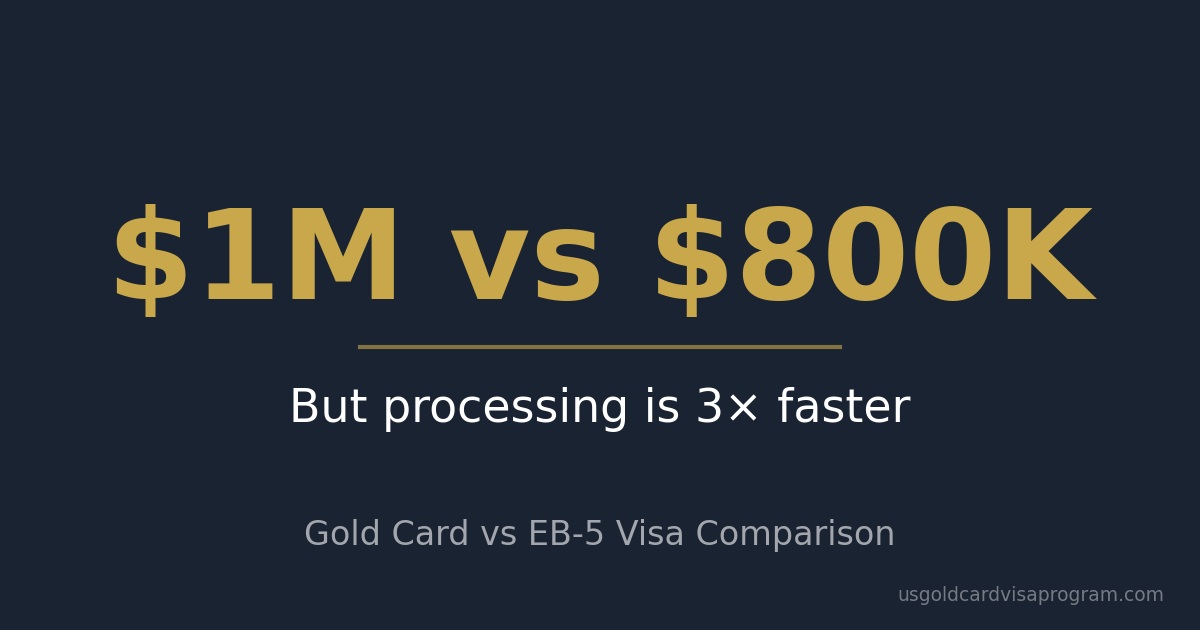
The Gold Card, launched in December 2025 at trumpcard.gov, offers tiered pricing—$1 million (Gold individual), $2 million (Corporate), and $5 million (Platinum, not yet available)—plus a $15,375 processing fee per person, and promises streamlined access to permanent residency. The Gold Card payment is a non-refundable contribution (gift) to the U.S. government, not a traditional investment. The EB-5 program, a decades-old government immigration pathway, requires an $800,000 to $1.05 million investment with strict job creation requirements.
Choosing between these options requires understanding exactly what each program delivers—and what it demands. This comprehensive comparison breaks down every critical factor so you can determine which path aligns with your immigration goals and financial situation.
What Is the Trump Gold Card?
The Trump Gold Card represents a residency program launched in December 2025 at trumpcard.gov. Marketed as a premium alternative to traditional investor visa pathways, the Gold Card requires a $1 million non-refundable contribution (plus $15,375 processing fee per person) and provides a direct pathway to U.S. permanent residency.
The program operates through the Trump Organization’s private venture, working in conjunction with existing immigration frameworks. Unlike standard government programs, the Gold Card is not administered by U.S. Citizenship and Immigration Services (USCIS) in the traditional sense. Instead, it leverages the existing EB-5 infrastructure (and the same EB-1A category used by O-1 visa holders) while adding premium concierge services and allegedly faster processing.
The Gold Card positions itself as an expedited, simplified option for ultra-high-net-worth individuals who value speed and convenience over cost savings. It includes perks such as dedicated case management, white-glove application handling, and access to exclusive program benefits.
Important disclaimer: The Gold Card is a private commercial product. Prospective buyers should conduct thorough due diligence, verify all claims independently, and consult qualified immigration attorneys before committing funds. See our guide on choosing an immigration attorney. Immigration law is complex, and private programs do not override federal requirements.
Gold Card applicants file Form I-140G, which is distinct from the EB-5’s Form I-526. Our step-by-step application guide walks through the full process. The application is submitted through trumpcard.gov.
What Is the EB-5 Immigrant Investor Program?
The EB-5 Immigrant Investor Program established by Congress in 1990, offers a path to U.S. permanent residency for foreign nationals who invest in qualifying U.S. businesses that create jobs.
The program requires a minimum investment of $800,000 in a Targeted Employment Area (TEA)—a rural area or location with high unemployment—or $1,050,000 in a non-TEA location. Investors must demonstrate that their investment will create or preserve at least 10 full-time jobs for qualifying U.S. workers within a specified timeframe.
The EB-5 process involves several stages. First, investors file Form I-526 with USCIS demonstrating the lawful source of funds and the investment’s viability. After approval, investors apply for conditional permanent residency (either through adjustment of status if in the U.S. or consular processing abroad). Approximately 21 months later, investors file Form I-829 to remove conditions by demonstrating job creation.
The EB-5 program is a government-administered pathway with established regulations, known processing times, and documented approval rates—though these have fluctuated over the years.
Free Gold Card Visa Guide
Get our Gold Card guide with cost breakdowns, timelines, and attorney tips. Delivered instantly to your inbox.
No spam. Unsubscribe anytime.
Cost Comparison: Gold Card vs EB-5
The most immediately apparent difference lies in the price. See our complete Gold Card cost breakdown for full details.
The Trump Gold Card offers tiered pricing: $1 million (Gold individual), $2 million (Corporate), and $5 million (Platinum, not yet available). Each tier also incurs a $15,375 processing fee per person. The Gold Card contribution is a non-refundable gift to the U.S. government, not a traditional investment. Each tier also requires a $15,375 processing fee per person. The contribution covers expedited processing, concierge services, and program management.
The EB-5 program requires a minimum investment of $800,000 for TEA projects or $1,050,000 for non-TEA investments. Beyond the base investment, applicants should budget for attorney fees ($15,000-$50,000+), filing fees (currently around $460 for Form I-526, $3,950 for Form I-829), and due diligence costs for project vetting.
When comparing amounts, the Gold Card’s $1 million contribution represents a 1.25x premium over the EB-5’s $800,000 TEA minimum. However, the fundamental difference is that the Gold Card payment is a non-refundable gift, while the EB-5 is a recoverable at-risk investment with potential returns. The higher Corporate ($2M) and Platinum ($5M, not yet available) tiers exist for different applicant categories.
Processing Time Comparison
Time represents one of the most significant variables between these two pathways. See our detailed analysis of Gold Card processing times.
The Gold Card claims expedited processing, with marketing materials suggesting approval timelines measured in months rather than years. However, prospective investors should approach these claims with caution. The underlying immigration process still requires government review, and actual processing depends on case complexity, background checks, and current USCIS workload.
The EB-5 program is notorious for extended processing times. As of 2026, Form I-526 processing averages 2-4 years, though this varies significantly by investor nationality and case specifics. The consular processing or adjustment of status adds additional time. Total timelines from application to green card commonly reach 3-5 years, and in some cases longer.
For investors seeking the fastest path to permanent residency, the Gold Card’s promised expedited timeline appears advantageous on the surface. However, verify all claims independently and understand that government processing ultimately controls final timelines.
Requirements and Eligibility
The eligibility requirements differ substantially between these programs. Review our guide on who qualifies for the Gold Card for detailed criteria.
Gold Card requirements are presented as relatively straightforward:
- $1 million non-refundable contribution (Gold individual tier), plus $15,375 processing fee per person; higher tiers available at $2M (Corporate) and $5M (Platinum, not yet available)
- Clean background check
- No explicit source of funds documentation requirements (though banks will likely require this)
- No job creation mandate
EB-5 requirements are more complex and regulated:
- Minimum investment amount ($800K or $1.05M depending on location)
- Investment must be at-risk (not guaranteed return)
- Source of funds must be thoroughly documented and lawful
- Must create or maintain 10 full-time jobs for U.S. workers
- Investment must remain at-risk throughout the conditional residency period
The Gold Card’s simplified requirements appeal to investors who lack the patience or documentation for EB-5 source of funds requirements. However, note that any green card pathway ultimately requires demonstrating lawful entry and admissible status—private programs cannot circumvent fundamental immigration law.
Benefits and Advantages
Each program offers distinct advantages worth considering.
Gold Card advantages:
- Higher contribution amount may attract faster government attention
- Alleged expedited processing
- Simplified application process (marketed as “concierge” service)
- No explicit job creation requirement
- Potentially less rigorous source of funds documentation
EB-5 advantages:
- Lower base investment ($800K vs $1M+ for Gold Card)
- Established, predictable government program with defined regulations
- Transparent processing times and approval statistics
- Multiple project options across various industries
- Decades of case law and precedent
- Path to citizenship after five years of permanent residency
The EB-5 program offers proven infrastructure and regulatory clarity. The Gold Card offers potential speed and simplicity, with tiered pricing to match different contribution levels.
Risks and Disadvantages
Both pathways carry inherent risks that investors must understand.
Gold Card risks:
- Limited track record (program launched December 2025)
- Private venture—not a government program with established oversight
- High cost provides no guarantee of approval or faster processing
- Less regulatory protection compared to established programs
- Marketing claims may exceed actual delivery capability
- Potential reputational concerns associated with the program’s branding
EB-5 risks:
- Investment at-risk requirement means capital can be lost
- Job creation requirements must be met or green card can be revoked
- Processing delays have historically caused extended timeframes
- Project failure can jeopardize both investment and immigration status
- Significant documentation burden for source of funds
- Visa retrogression for certain nationalities (especially Chinese, Vietnamese, Indian nationals)
The EB-5 program carries investment risk that is well-documented. The Gold Card contribution is non-refundable (not an at-risk investment like EB-5), and the program carries maturity risk due to its newness.
Who Is Each Program Best For?
Understanding target demographics helps clarify which pathway suits specific situations.
The Gold Card is best suited for:
- High-net-worth individuals ($1M+ liquid assets for Gold tier; Platinum tier is not yet available)
- Investors who prioritize speed and convenience over cost savings
- Those seeking maximum simplicity in the application process (including crypto entrepreneurs)
- Individuals who prefer premium, white-glove service experiences
- Investors without complex source of funds documentation challenges
The EB-5 is best suited for:
- Investors seeking lower capital thresholds ($800K-$1.05M)
- Those who prefer established, government-regulated programs
- Investors comfortable with at-risk investment requirements
- Individuals who want maximum regulatory protection and transparency
- Those willing to navigate source of funds documentation for savings
The decision ultimately depends on individual priorities, timeline constraints, and financial circumstances. Be sure to review the tax implications of either pathway before committing.
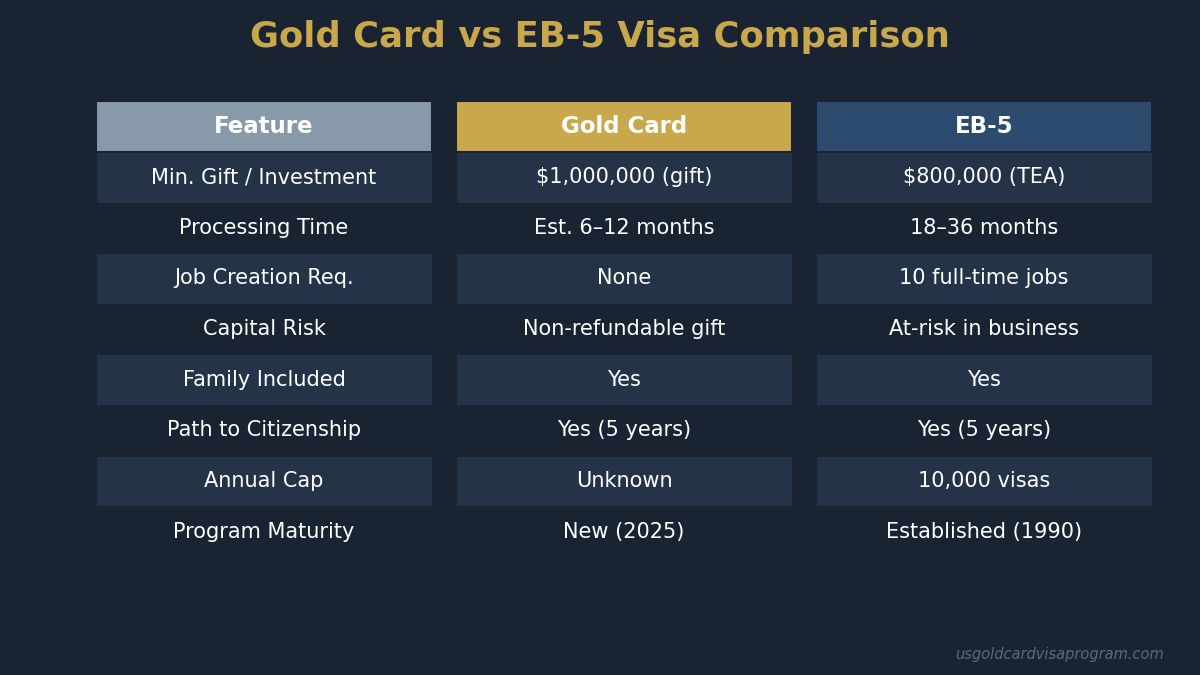
Trump Gold Card vs EB-5: Comparison Table
| Factor | Trump Gold Card | EB-5 Visa |
| Minimum Cost | $1,000,000 (individual gift/contribution) + $15,375 processing fee per person | $800,000 – $1,050,000 |
| Processing Time (Claimed/Estimated) | Months (unverified) | 2-5+ years |
| Job Creation Required | Not explicitly | 10 full-time U.S. jobs |
| Source of Funds Documentation | Marketed as simplified | Required (extensive) |
| Program Type | Private venture | Government program |
| Track Record | New (December 2025) | Established (since 1990) |
| Capital at Risk | No — non-refundable contribution (gift) | Yes (required) |
| Path to Citizenship | Yes, after 5 years | Yes, after 5 years |
| Regulatory Oversight | Limited | Full (USCIS) |
| Best For | Ultra-wealthy, speed priority | Cost-conscious, transparency priority |
Frequently Asked Questions
For more answers, see our comprehensive Gold Card Visa FAQ with 25 questions answered.
Is the Trump Gold Card a government program?
No. The Trump Gold Card is a private commercial product marketed by the Trump Organization. It is not a U.S. government immigration program like the EB-5. While it may utilize existing immigration pathways, prospective buyers should understand they are purchasing a private service, not applying through a government agency.
Can the Gold Card guarantee approval?
No immigration pathway can guarantee approval. The Gold Card, like all visa programs, requires government review and can be denied. Any program promising guaranteed approval should be viewed with extreme skepticism. Green card applications require thorough background checks and must meet all applicable legal requirements.
Is EB-5 still processing in 2026?
Yes, the EB-5 program continues to operate in 2026. However, processing times remain extended, and investors should anticipate multi-year timelines. Some reform proposals have circulated in Congress, but the program remains active as of this writing.
What happens if EB-5 investment loses money?
The EB-5 requirement mandates that investment capital remain “at-risk.” If a project fails or loses value, the investor may lose capital while still maintaining their immigration path if job creation requirements are met. The investment loss does not automatically jeopardize the green card, but financial losses are possible.
Can I get a refund if my Gold Card application is denied?
This depends on the specific terms and conditions of the Gold Card program. Unlike government programs with established refund policies, private ventures set their own terms. Prospective buyers should carefully review all contracts and understand refund policies before committing funds.
Do I need to speak English for either program?
No formal English language requirement exists for either the Gold Card or EB-5. However, the immigration interview process is conducted in English, and applicants should demonstrate basic conversational ability. Waiver options exist for certain categories.
Which is faster: Gold Card or EB-5?
The Gold Card claims significantly faster processing, but these claims remain unverified due to the program’s newness. The EB-5 program has documented processing times of 2-5+ years. However, investors should approach any speed claims with caution until the Gold Card establishes a verifiable track record.
Conclusion: Making Your Decision
The choice between the Trump Gold Card and EB-5 Visa ultimately depends on your individual circumstances, priorities, and risk tolerance.
The Gold Card offers a premium, expedited pathway with a $1 million non-refundable contribution for individual applicants (plus $15,375 processing fee per person). Corporate ($2M) and Platinum ($5M, not yet available) tiers also exist. The Gold Card payment is a gift, not a recoverable investment. Its main advantages include simplified requirements and expedited processing, though the program’s track record is still developing compared to the established EB-5 pathway.
The EB-5 program provides a proven, government-regulated route at lower investment thresholds ($800K-$1.05M). While processing is slower and requirements are more stringent, EB-5 offers regulatory protections, established precedent,
Free Download: The Complete Gold Card Visa Guide 2026
Get our comprehensive PDF guide — Gold Card vs EB-5, qualification checklist, attorney selection guide, and more.
Related: Trump Gold Card Lawsuit: Legal Challenges and Risks for Investors [2026 Updates]
Considering alternatives? Read our Gold Card vs Portugal Golden Visa comparison.
Stay Updated on Gold Card Visa Changes
Get real-time updates on policy changes, processing times, and legal developments. Free newsletter, no spam.
This article is for informational purposes only and does not constitute legal or immigration advice. Consult a qualified immigration attorney before making any decisions.
Related Guides
Country-Specific Gold Card Guides
- Gold Card Visa for Indian Citizens — RBI/FEMA rules, INR conversion, backlog bypass
- Gold Card Visa for Chinese Investors — SAFE regulations, capital controls, CNY conversion
- Gold Card Visa for UAE/Gulf Investors — Tax-free to US tax, AED conversion, Golden Visa comparison
- Gold Card Visa for British Citizens — GBP conversion, UK-US tax treaty, dual citizenship
- Gold Card Visa for Nigerian Citizens — CBN restrictions, NGN conversion, scam warnings
About the Editorial Team
This article was researched and written by the editorial team at usgoldcardvisaprogram.com. We specialize in US immigration investment programs and provide well-researched, regularly updated content. Our information is sourced from official government publications, immigration law firms, and verified policy documents. This content does not constitute legal or financial advice.
Need Help Finding the Right Immigration Attorney?
The Gold Card requires specialized legal expertise. We've put together a guide on what to look for.
Find a Gold Card Attorney →