
Gold Card Visa vs Portugal Golden Visa: Full Comparison 2026
Two Paths to Residency — Overview
For high-net-worth individuals exploring international residency options, two programs have emerged as subjects of intense discussion in 2026: the US Gold Card Visa and the long-established Portugal Golden Visa. Each represents a fundamentally different approach to investment-based immigration, and understanding the distinctions between them is essential for anyone weighing their global mobility strategy.
The US Gold Card Visa is a pathway to American permanent residency that requires a substantial, non-refundable contribution (gift) to the U.S. government. The program launched in December 2025 and is now accepting applications at trumpcard.gov. It offers a tiered pricing structure: $1 million for individual Gold Card applicants (plus $15,375 processing fee per person), $2 million for corporate applicants, and $5 million for the Platinum tier (which requires Congressional approval and is not yet available). The program provides a streamlined route to a US green card for qualified investors willing to make a significant financial commitment to the United States.
Portugal’s Golden Visa, on the other hand, has been operational since 2012 and has granted residency to thousands of international investors. While the program underwent major changes in 2023 when the real estate investment route was eliminated, the fund investment pathway remains active, requiring a minimum commitment of €500,000 in qualifying Portuguese investment funds. Portugal’s program offers a pathway to both European residency and, eventually, citizenship and an EU passport.
These two programs differ not only in cost and geography but in philosophy. The US Gold Card represents a high-threshold, fee-based model where the investment is a non-refundable contribution. Portugal’s Golden Visa is structured around recoverable capital deployed into funds that the investor may eventually recoup. This core distinction shapes every subsequent comparison point, from tax treatment to long-term financial planning.
In this guide, we break down every major dimension of both programs so you can evaluate which path, if either, aligns with your personal circumstances and objectives.
Investment Requirements Compared
The investment requirements for these two programs are dramatically different, not just in amount but in the fundamental nature of the capital commitment.
The US Gold Card Visa requires a non-refundable contribution (gift) starting at $1 million for individual applicants (plus $15,375 processing fee per person), $2 million for corporate applicants, or $5 million for the Platinum tier (not yet available, requires Congressional approval). This is not equity in a business, real estate, or a fund. It is a gift paid to the US government in exchange for permanent residency, not a traditional investment with an expected return. Once paid, this capital is not recoverable. For investors, this means the Gold Card fee must be viewed as a pure cost of obtaining US residency status, not as a traditional investment with an expected return.
Portugal’s Golden Visa, by contrast, requires a minimum investment of €500,000 (approximately $540,000 at current exchange rates) into qualifying investment funds. These are regulated funds that invest in Portuguese businesses, venture capital, or other approved asset classes. Critically, this capital remains the property of the investor. While fund investments carry inherent market risk and are subject to lock-up periods typically lasting five to seven years, the investor retains ownership of fund units and can expect to recover their capital, potentially with returns, once the holding period expires.
The difference in scale is striking: even the entry-level US Gold Card at $1 million costs roughly twice what the Portugal Golden Visa requires, and the corporate tier at $2 million is nearly four times the cost. But even more significant is the difference in capital treatment. An investor choosing the US path must be comfortable with a permanent, irrecoverable expenditure. An investor choosing Portugal deploys their capital into a vehicle where the principal may be returned.
For ultra-high-net-worth individuals, the Gold Card fee (starting at $1 million for individuals) may represent an acceptable cost for direct access to the American market. For investors with more modest portfolios, Portugal’s lower threshold and recoverable investment structure may be far more practical. Regardless of your financial position, it is important to consult qualified financial advisors to understand how either investment would affect your overall portfolio and liquidity.
Free Gold Card Visa Guide
Get our Gold Card guide with cost breakdowns, timelines, and attorney tips. Delivered instantly to your inbox.
No spam. Unsubscribe anytime.
Residency Rights and Benefits
The residency rights granted by each program differ substantially, reflecting the broader immigration frameworks of the United States and Portugal.
The US Gold Card Visa is designed to grant permanent residency, commonly known as a green card. A US green card confers the right to live and work anywhere in the United States without restriction. Green card holders enjoy nearly all the rights of US citizens, including access to the US labor market, the ability to own and operate businesses, and protection under US law. Green card holders can sponsor certain family members for their own green cards, though the process can take years depending on family category and country of origin.
The US green card also provides significant global travel advantages. US permanent residents can travel to numerous countries without visas or with visa-on-arrival access, though the specific benefits depend on the traveler’s passport. More importantly, residing in the US provides access to the world’s largest economy, its financial markets, its educational institutions, and its healthcare system.
Portugal’s Golden Visa initially grants a temporary residency permit, renewable in two-year cycles. This temporary permit allows the holder to live, work, and study in Portugal. After five years of legal residency, the holder can apply for permanent residency or directly for Portuguese citizenship. One of the most attractive features of the Portugal program is the minimal physical presence requirement: investors need to spend only seven days per year in Portugal during the first year and fourteen days in each subsequent two-year renewal period.
A Portuguese residency permit also provides Schengen Zone access, allowing holders to travel freely across 27 European countries. Upon obtaining Portuguese citizenship, the investor receives an EU passport, which grants the right to live, work, and do business anywhere in the European Union. An EU passport is consistently ranked among the most powerful travel documents in the world, providing visa-free access to over 180 countries.
Family inclusion is available under both programs, though the specifics vary. The US Gold Card allows inclusion of immediate family members, consistent with existing green card provisions for spouses and minor children. Portugal’s Golden Visa allows inclusion of a spouse or partner, dependent children, and in some cases dependent parents, all under the same application. Portugal’s family inclusion provisions are often cited as particularly generous compared to other investment migration programs.
Path to Citizenship
Both programs ultimately offer a pathway to citizenship, but the requirements and timelines differ in important ways.
In the United States, a green card holder becomes eligible to apply for US citizenship through naturalization after five years of continuous permanent residency. The naturalization process requires the applicant to demonstrate physical presence in the US for at least 30 months during the five-year period, with no single absence exceeding one year. Applicants must pass an English language test and a civics exam covering US history and government. They must also demonstrate good moral character and pay the applicable filing fees.
US citizenship confers the right to vote, hold a US passport, and access the full range of government services and protections available to Americans. However, the United States generally does not recognize dual citizenship in a formal sense, though it does not actively require renunciation of other nationalities. This is a complex area where qualified legal counsel is essential.
Portugal offers eligibility for citizenship after five years of legal residency. The Portuguese language requirement is set at A2 level under the Common European Framework of Reference, which represents a basic conversational ability. This is a lower threshold than many European citizenship-by-naturalization programs require. Portugal also requires applicants to demonstrate ties to the community and a clean criminal record.
Notably, Portugal explicitly allows dual citizenship. An investor who obtains Portuguese citizenship does not need to renounce their existing nationality. This is a significant advantage for investors who wish to hold multiple passports and maintain flexibility across jurisdictions. A Portuguese passport, as an EU passport, opens the door to living and working in any EU member state, effectively multiplying the residency options available to the investor.
The physical presence requirements also differ markedly. The US requires substantial physical presence over the five-year period before citizenship eligibility. Portugal’s Golden Visa, as noted, requires only minimal time spent in Portugal, making it far more compatible with investors who wish to maintain their primary residence in another country while building toward European citizenship.
Tax Implications — US vs Portugal
Tax treatment is arguably the single most consequential difference between these two residency programs, and it demands careful attention from any prospective applicant.
The United States taxes its residents and citizens on worldwide income, regardless of where that income is earned or where the individual physically resides. (For a deeper dive into US Gold Card tax obligations, see our full guide to Gold Card tax implications.) This means that a Gold Card holder living in the US would be subject to federal income tax, state income tax (depending on the state of residence), capital gains tax, estate tax, and gift tax on their global assets and income. The US tax system is comprehensive and applies to all forms of income, including foreign business profits, rental income from properties abroad, investment gains, and more.
For high-net-worth individuals with complex international financial structures, US tax residency can represent a significant and ongoing cost. The US also requires extensive financial reporting, including the Foreign Bank Account Report (FBAR) for accounts held outside the US exceeding $10,000 in aggregate, and the FATCA (Foreign Account Tax Compliance Act) reporting requirements. Non-compliance with these reporting obligations can result in severe penalties.
It is important to understand that even if you later decide to relinquish your US green card, you may be subject to an exit tax on unrealized capital gains if you have held the card for eight or more of the previous fifteen tax years. The decision to become a US tax resident should be made with the full understanding of both the immediate and long-term tax consequences.
Portugal offers a markedly different tax environment. While Portugal’s standard personal income tax rates can be high for domestic income, the country introduced the Non-Habitual Resident (NHR) tax regime, which provided significant tax advantages to new residents for a period of ten years. Under NHR, qualifying individuals could benefit from flat tax rates on certain Portuguese-source income and exemptions on many forms of foreign-source income, including dividends, interest, royalties, and capital gains originating outside Portugal.
It is important to note that the NHR regime has undergone changes, and prospective applicants should consult tax professionals for the most current rules and eligibility requirements. Portugal has introduced modifications to the program in response to both domestic political pressure and EU scrutiny. Regardless of the specific tax regime available, Portugal does not tax on a worldwide basis in the same comprehensive manner as the United States, making it generally more favorable for individuals with significant international income streams.
The contrast is clear: the US applies a broad worldwide tax net, while Portugal historically offers more targeted taxation that can be significantly more favorable for internationally mobile investors. However, tax planning in either jurisdiction is deeply personal and depends on your specific income sources, asset structure, existing tax obligations, and long-term plans. Professional tax advice from advisors licensed in the relevant jurisdictions is not optional but essential.
Processing Timeline and Certainty
When evaluating any residency-by-investment program, the maturity of the program and the predictability of the process are critical considerations.
The US Gold Card Visa launched in December 2025 and is now accepting applications at trumpcard.gov. As a newly operational program, processing timelines are still being established and there is a limited track record of approved cases. The program’s structure and procedures may continue to evolve as the administration refines the process. The Platinum tier ($5 million) still requires Congressional approval and is not yet available. Investors interested in the Gold Card should monitor developments closely and work with qualified immigration attorneys for the latest guidance.
The uncertainty surrounding the Gold Card extends beyond processing times. New immigration programs often experience initial bottlenecks as government agencies establish procedures, train staff, and work through the first wave of applications. Even after launch, early applicants may face longer processing times and less predictable outcomes compared to applicants in a mature program.
Portugal’s Golden Visa, by contrast, has been operational since October 2012. Over more than a decade, the program has processed thousands of applications and established a clear, well-documented procedural framework. Applicants can consult extensive historical data on approval rates, processing times, and common issues. Typical processing times for a Portugal Golden Visa application range from six to twelve months from the date of investment to the issuance of the initial residency card, though times can vary depending on the applicant’s circumstances and the current caseload at the Portuguese immigration authority (AIMA).
The established nature of Portugal’s program also means there is a robust ecosystem of service providers, including immigration lawyers, fund managers, tax advisors, and relocation consultants, who specialize in guiding investors through the process. This professional infrastructure reduces risk and increases the predictability of the outcome. While no immigration program offers guaranteed approval, Portugal’s long track record provides a level of certainty that a brand-new program simply cannot match.
For investors who need residency within a defined timeframe, the certainty gap between these two programs is a decisive factor. Portugal offers a known process with predictable timelines. The US Gold Card, while now accepting applications, is still in its early stages and has yet to build the track record that Portugal offers.
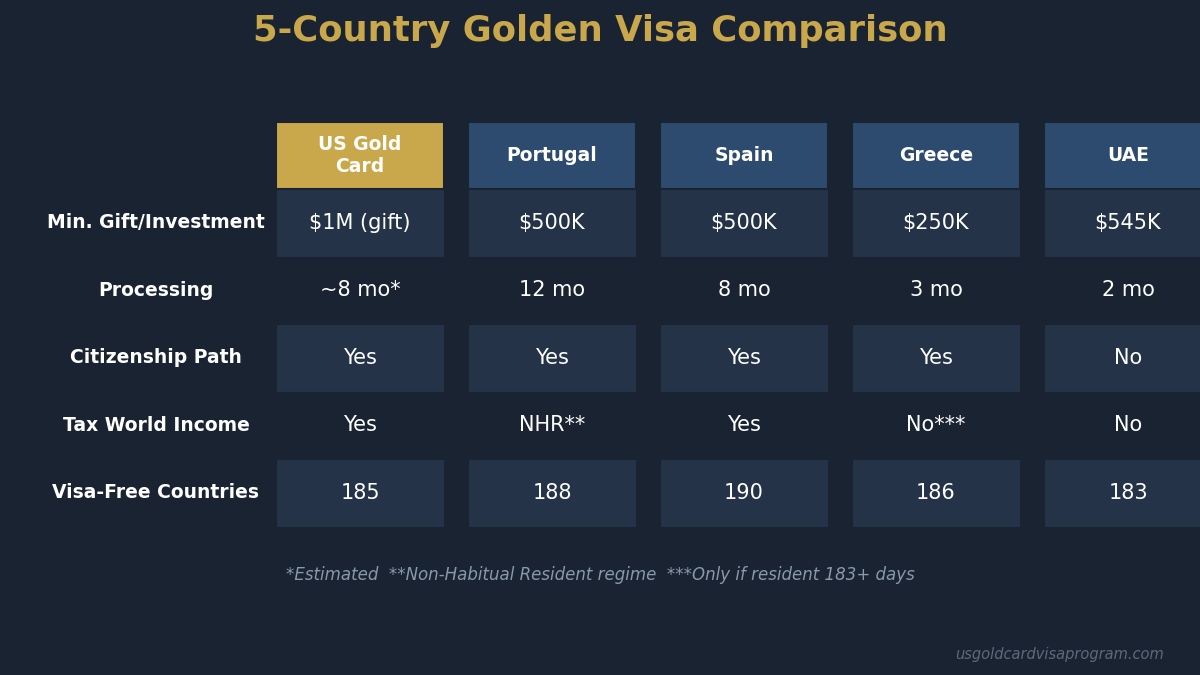
Side-by-Side Comparison Table
Which Program Is Right for You?
Choosing between the US Gold Card Visa and Portugal’s Golden Visa is not a matter of one program being objectively superior to the other. Each serves different investor profiles, objectives, and life circumstances. The right choice depends entirely on your individual priorities.
The US Gold Card may be the better fit if:
- Your primary goal is permanent access to the US market, whether for business operations, career opportunities, or proximity to the American economy and its financial infrastructure.
- You have sufficient net worth to absorb the non-refundable Gold Card contribution (starting at $1 million for individuals, plus $15,375 processing fee per person) without materially affecting your financial security or liquidity.
- You are willing to accept US worldwide taxation because your income structure, business interests, or personal goals are already aligned with the American market.
- You intend to physically reside in the United States and build your primary life there, satisfying the substantial physical presence requirements for maintaining your green card and eventually qualifying for citizenship.
- You value the specific advantages of US residency, including access to American universities for your children, the depth of the US capital markets, and the legal protections available to US residents.
Portugal’s Golden Visa may be the better fit if:
- You want residency in the European Union with a clear and proven path to an EU passport, granting you the right to live and work across all 27 EU member states.
- You prefer a lower investment threshold with the possibility of recovering your capital after the required holding period, preserving more of your wealth for other purposes.
- You do not want to commit to living full-time in any single country and value the minimal physical presence requirement that allows you to maintain your lifestyle elsewhere while building toward European citizenship.
- Tax efficiency is a priority, and you want to take advantage of tax regimes that do not impose worldwide taxation on all forms of income, subject to current rules and eligibility.
- You prefer a program with a long-established track record and clear timelines over a newly launched program that is still building its processing history.
- You value dual citizenship and want to add a European passport to your portfolio without relinquishing your existing nationality.
For some investors, the decision framework is straightforward. An entrepreneur planning to build a technology company in Silicon Valley has a clear reason to pursue US residency. A family seeking a European base with access to international schools and the ability to travel freely across Europe may find Portugal more compelling. But for many high-net-worth individuals, the decision is more nuanced and involves balancing multiple priorities across business, family, tax, and lifestyle dimensions.
Whatever your situation, the decision to pursue residency in any country represents a major life and financial commitment. It should be made after thorough due diligence, with the guidance of qualified immigration attorneys, tax advisors, and financial planners who understand your complete picture.
Can You Apply for Both?
There is no legal prohibition against pursuing residency in multiple countries simultaneously, and some investors do choose to apply for more than one residency-by-investment program as part of a broader global mobility strategy. Holding residency in both the United States and Portugal is technically possible, though it introduces significant complexity, particularly regarding tax obligations.
If you hold both a US green card and Portuguese residency, you would be subject to US worldwide taxation on all income, regardless of its source. You would also need to comply with Portuguese tax regulations for any income sourced from or connected to Portugal. The interaction between the US and Portuguese tax systems would be governed by the bilateral tax treaty between the two countries, but navigating dual tax obligations requires expert guidance to avoid double taxation and ensure full compliance with both jurisdictions.
From a practical standpoint, some investors are applying for both programs simultaneously or sequentially as part of a broader global mobility strategy. Portugal’s program has a longer track record and more predictable timelines, while the Gold Card is now accepting applications at trumpcard.gov but is still in its early operational phase. An investor could pursue both programs to maximize their global residency options.
However, dual residency is not a strategy to pursue casually. The financial, legal, and administrative burdens of maintaining compliance in two countries are substantial. Before pursuing multiple residency programs, consult with qualified immigration and tax professionals who can assess your specific situation and advise on the feasibility and implications of a multi-jurisdiction strategy.
Key Takeaways
The US Gold Card Visa and Portugal’s Golden Visa represent two fundamentally different approaches to investment-based immigration, each with distinct advantages and trade-offs.
- Investment scale: The US Gold Card requires $1 million (individual, plus $15,375 processing fee per person), $2 million (corporate), or $5 million (Platinum tier, not yet available) as a non-refundable gift/contribution, while Portugal requires €500,000 in a recoverable fund investment. The difference in both amount and capital treatment is the most immediately obvious distinction between the programs.
- Program status: Portugal’s Golden Visa is an established program with a proven track record since 2012. The US Gold Card launched in December 2025 and is now accepting applications at trumpcard.gov, though as a new program it has a limited track record. This difference in maturity has practical implications for timeline certainty and risk assessment.
- Tax treatment: The US imposes worldwide taxation on all residents and citizens. Portugal offers a more favorable tax environment for international income, particularly under applicable tax regimes. For investors with substantial international income, this difference can have major long-term financial consequences.
- Residency and citizenship: Both programs offer pathways to citizenship after approximately five years. The US requires substantial physical presence, while Portugal requires minimal time in-country. Portugal allows dual citizenship without restriction, adding flexibility for globally mobile investors.
- Geographic access: The US Gold Card provides access to the American market and economy. Portugal provides access to the entire European Union via Schengen and, upon citizenship, full EU rights. The right choice depends on where you want to live, work, and build your future.
- Professional guidance is essential: Both programs involve complex legal, tax, and financial considerations. No article can substitute for personalized advice from qualified immigration attorneys, tax advisors, and financial planners who understand your complete situation.
The landscape of investment migration is evolving rapidly. Whether you are drawn to the scale and ambition of the US Gold Card or the established reliability and European access of Portugal’s Golden Visa, the most important step is to gather accurate information, seek expert counsel, and make a decision that aligns with your long-term goals and values.
Related: Source of Funds Documentation Guide | Gold Card Visa FAQ | Gold Card Lawsuit Updates | Gold Card vs O-1 Visa | Gold Card for Crypto Entrepreneurs
📋 Free Download: The Complete Gold Card Visa Guide 2026
Get our comprehensive PDF guide — Gold Card vs EB-5, qualification checklist, attorney selection guide, and more.
No spam. Unsubscribe anytime.
Stay Updated on Gold Card Visa Changes
Get real-time updates on policy changes, processing times, and legal developments. Free newsletter, no spam.
About the Editorial Team
This article was researched and written by the editorial team at usgoldcardvisaprogram.com. We specialize in US immigration investment programs and provide well-researched, regularly updated content. Our information is sourced from official government publications, immigration law firms, and verified policy documents. This content does not constitute legal or financial advice.
Need Help Finding the Right Immigration Attorney?
The Gold Card requires specialized legal expertise. We've put together a guide on what to look for.
Find a Gold Card Attorney →