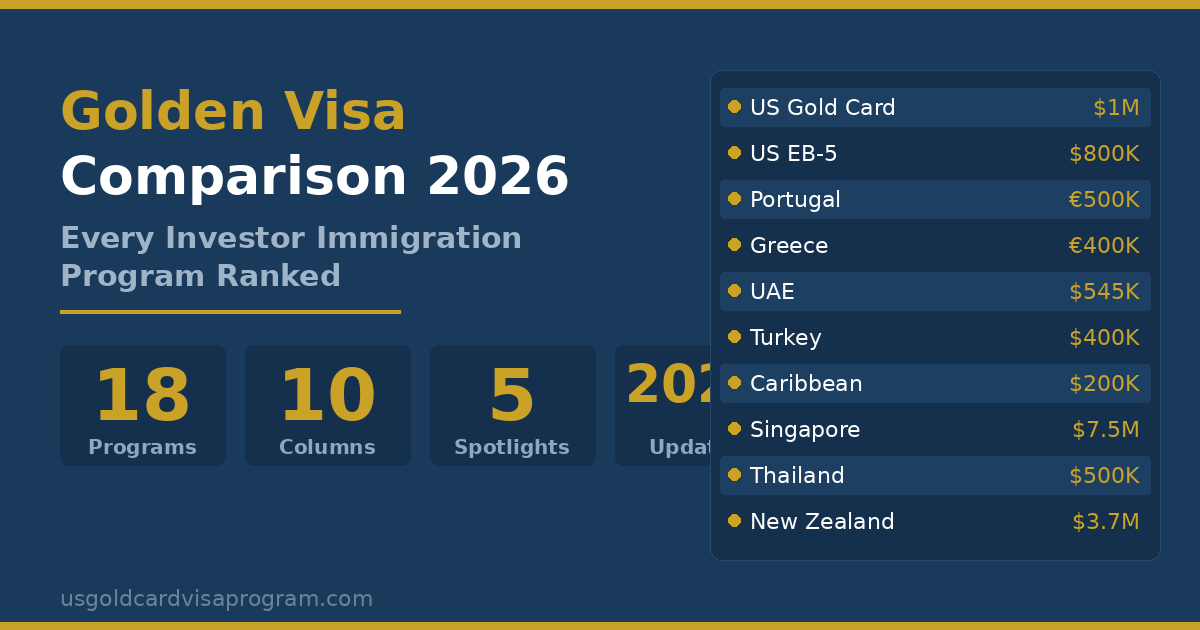
The Investor Immigration Landscape in 2026
The global investor immigration market has undergone a seismic shift. In just three years, three of Europe’s most popular golden visa programs have shut their doors — the UK Tier 1 Investor visa in February 2022, Ireland’s Immigrant Investor Programme in February 2023, and Spain’s Golden Visa in April 2025. Australia replaced its Business Innovation and Investment Program with a merit-based National Innovation Visa. Even Canada has paused its Start-Up Visa and pivoted to a pilot with stricter requirements.
At the same time, entirely new pathways have emerged. The Trump Gold Card visa, launched in December 2025 under Executive Order 14351, introduced a $1 million “gift” model that has no precedent in immigration history. The UAE continues to expand its Golden Visa, Thailand’s Long-Term Resident visa is gaining momentum, and the Caribbean nations remain the fastest route to a second passport.
Whether you’re a high-net-worth individual weighing your options, a tax advisor counseling clients, or an immigration attorney structuring cases, this comparison covers every major investor immigration program in the world as of March 2026 — including programs that have recently closed, since applicants in the pipeline may still be affected.
Bookmark this page. We update it monthly as programs change, thresholds shift, and new pathways open.
The Complete Golden Visa Comparison Table
This table compares 18 investor immigration programs across the metrics that matter most: cost, investment type, family inclusion, processing speed, and path to citizenship. Programs marked CLOSED are no longer accepting new applications.
| Country / Program | Minimum Investment | Investment Type | Refundable? | Family Included? | Processing Time | Path to Citizenship | Residency Required? | Tax Implications | Status |
|---|---|---|---|---|---|---|---|---|---|
| 🇨🇸 US Gold Card | $1,000,000 + $15,375 fees | Non-refundable gift to Dept. of Commerce | No | No — each family member needs own $1M + $15K | Expedited (est. 6–12 months) | Green card → citizenship in 5 years | Standard green card rules (continuous residence) | Full US worldwide income tax | Active |
| 🇨🇸 US EB-5 | $800,000 (TEA) / $1,050,000 (non-TEA) | Job-creating investment in US business | Yes (after conditions removed, ~7–10 years) | Yes — spouse + unmarried children under 21 | 2–5 years (longer for China/India backlogs) | Green card → citizenship in 5 years | Standard green card rules | Full US worldwide income tax | Active |
| 🇵🇹 Portugal Golden Visa | €500,000 | Investment fund (real estate route closed) | After 5-year hold period | Yes — spouse, children, dependent parents | 6–12 months | Citizenship in 5 years | Minimal (7 days in year 1, 14 days in subsequent years) | NHR regime available (flat 20% on Portuguese income) | Active (fund route only) |
| 🇪🇸 Spain Golden Visa | €500,000 (was real estate) | Real estate (was primary route) | N/A | N/A | N/A | Was 10 years to citizenship | N/A | N/A | CLOSED (Apr 2025) |
| 🇬🇷 Greece Golden Visa | €400,000 (standard) / €800,000 (prime areas) | Real estate | Yes (sell property after hold period) | Yes — spouse, children under 21, parents | 6–9 months | Citizenship in 7 years (strict residency) | No minimum for visa; 183+ days/year for citizenship | Flat tax option (€100K/year) for new residents | Active |
| 🇮🇪 Ireland IIP | €1,000,000 (was investment/donation) | Enterprise investment or endowment | N/A | N/A | N/A | Was citizenship in 5 years | N/A | N/A | CLOSED (Feb 2023) |
| 🇲🇹 Malta MEIN | €690,000+ (donation + property + contribution) | Non-refundable govt. contribution + property lease/purchase | No (donation component) | Yes — spouse, children, parents/grandparents | 12–14 months (fast-track) / 36 months (standard) | Direct citizenship | 12+ months residency before citizenship (36-month track); genuine link | Remittance-based tax (foreign income taxed only if remitted) | Under reform (ECJ ruling Apr 2025) |
| 🇬🇧 UK Tier 1 Investor | £2,000,000 (was minimum) | UK share/loan capital | N/A | N/A | N/A | Was ILR in 2–5 years, citizenship in 6 | N/A | N/A | CLOSED (Feb 2022) |
| 🇦🇪 UAE Golden Visa | AED 2,000,000 (~$545,000) | Real estate, business ownership, or specialized talent | Yes (sell property anytime) | Yes — spouse, children, domestic staff | 2–4 weeks | No citizenship pathway (residence only) | No minimum stay requirement | No income tax, no capital gains tax, no wealth tax | Active |
| 🇨🇦 Canada Start-Up Visa | No minimum capital (need designated org. backing) | Venture capital, angel investor, or incubator support | N/A (no personal investment required) | Yes — spouse + dependent children | 12–36 months (historically) | Direct permanent residence → citizenship in 3 years | Must intend to reside in Canada | Canadian worldwide income tax | Paused (Jan 2026) |
| 🇦🇺 Australia NIV (replaced BIIP) | No fixed minimum (merit-based) | Innovation/entrepreneurship/talent contribution | N/A | Yes — spouse + dependent children | New program, timelines emerging | Permanent residence → citizenship in 4 years | Must be resident in Australia | Australian worldwide income tax | Active (NIV since Dec 2024) |
| 🇳🇿 NZ Active Investor Plus | NZD 5M (Growth) / NZD 10M (Balanced) | NZ business/managed fund investment | Yes (after 3–5 year hold) | Yes — spouse + dependent children | 6–12 months | Citizenship in 5 years | 21 days (Growth) / 105 days (Balanced) over full term | NZ worldwide income tax (foreign trust structures available) | Active |
| 🇸🇬 Singapore GIP | SGD 10,000,000 (~$7.5M) | Business investment + job creation (30 employees) | N/A (active business) | Yes — spouse + unmarried children under 21 | 6–9 months | Citizenship in 2 years (eligible to apply) | Must be substantially present | Territorial tax (foreign income generally not taxed) | Active |
| 🇰🇳 St Kitts & Nevis CBI | $250,000 (donation) / $325,000 (real estate) | Government fund donation or real estate | No (donation) / Yes (real estate after 7 years) | Yes — spouse, children, parents, siblings | 4–6 months | Direct citizenship | None | No income tax, no capital gains, no inheritance tax | Active |
| 🇩🇲 Dominica CBI | $200,000 (donation) / $200,000 (real estate) | Economic Diversification Fund or real estate | No (donation) / Yes (real estate after 3 years) | Yes — spouse, children, parents, grandparents, siblings | 6–9 months | Direct citizenship | None | No income tax, no capital gains, no inheritance tax | Active |
| 🇹🇷 Türkiye CBI | $400,000 (real estate) / $500,000 (bank deposit) | Real estate purchase or capital deposit | Yes (sell property after 3-year hold) | Yes — spouse + children under 18 | 3–6 months | Direct citizenship | None | Territorial elements; foreign income generally exempt if not remitted | Active |
| 🇹🇭 Thailand LTR | $500,000 (Thai assets) + income thresholds | Thai investment (property, bonds, funds) + income proof | Yes (investments are owned assets) | Yes — spouse + dependent children (expanded 2025) | 1–3 months | No citizenship pathway (10-year residence only) | Annual reporting (no day requirement) | 17% flat income tax for employees; foreign income generally exempt | Active |
| 🇲🇨 Monaco Residence | €500,000+ bank deposit (practical minimum; no official threshold) | Bank deposit + property lease/purchase | Yes (bank deposit is yours) | Yes — spouse + dependent children | 3–6 months | No citizenship (except by birth or marriage after 10+ yrs) | 3 months/year minimum | Zero income tax, zero capital gains, zero wealth tax | Active (no formal program) |
Table data verified from official government sources as of March 2026. Investment amounts shown in local currency with USD equivalents where helpful. Actual costs may vary based on due diligence fees, legal costs, and family size.
Program Spotlight: The Top 5 Programs
🇨🇸 US Gold Card — The New $1M Gift Model
Launched in December 2025 under Executive Order 14351, the Trump Gold Card is the most unconventional investor immigration pathway ever created by a major economy. Unlike every other program on this list, the Gold Card requires a non-refundable gift of $1,000,000 to the US Department of Commerce. This is not an investment — the money does not come back, does not earn returns, and does not purchase property or fund a business.
The program uses existing EB-1A (Extraordinary Ability) and EB-2 NIW (National Interest Waiver) visa categories, with applicants filing Form I-140G through trumpcard.gov. The $15,375 processing fee is paid upfront, followed by extensive USCIS vetting that includes 20-year employment history, education records, all financial accounts including cryptocurrency wallets, and source-of-funds documentation.
The most critical detail many sources get wrong: family members are NOT included. Each spouse and unmarried child under 21 requires their own separate $1,000,000 gift plus $15,375 in fees. A family of four faces a minimum outlay of $4,061,500. The separately announced Platinum Card ($5M) is a non-immigrant visitor visa — it is not yet available and is an entirely different product.
For applicants who qualify, the Gold Card offers a relatively fast path to a US green card with eventual citizenship eligibility after 5 years. The full cost breakdown is covered in our Gold Card Visa Cost Guide.
🇨🇸 US EB-5 — The Established Investment Route
The EB-5 Immigrant Investor Program has been the primary investment-based pathway to a US green card since 1990. At $800,000 for Targeted Employment Area (TEA) projects or $1,050,000 for non-TEA projects, it requires applicants to invest in a job-creating commercial enterprise that generates at least 10 full-time positions for US workers.
Unlike the Gold Card, EB-5 investments are refundable — in theory. After conditions are removed (typically 7–10 years from initial filing), investors can recoup their capital. However, the program has been plagued by fraud scandals, regional center closures, and processing backlogs. Form I-526E petitions currently take approximately 50–71 months to adjudicate, and applicants from China and India face additional per-country visa caps that can extend wait times to a decade or more.
The EB-5 Reform and Integrity Act of 2022 created reserved visa categories for rural TEA projects, offering priority processing for investors willing to place capital outside major metros. For a detailed head-to-head analysis, see our Gold Card vs EB-5 Comparison.
Bottom line: the EB-5 is cheaper than the Gold Card and the investment is technically refundable, but the wait times are dramatically longer, and your capital is at risk in a business venture for years.
🇵🇹 Portugal Golden Visa — Europe’s Most Popular Gateway
Portugal’s Golden Visa has been the gold standard of European investor immigration since its launch in 2012. After significant reforms in 2023 that eliminated the real estate route, the program now exclusively offers a €500,000 investment fund pathway. Applicants must invest in a Portuguese-regulated fund (CMVM-approved) that allocates at least 60% of capital within Portugal, held for a minimum of five years.
What makes Portugal extraordinary is the combination of minimal physical presence (just 7 days in the first year, 14 days per year thereafter), family inclusion (spouse, children, and dependent parents), and one of Europe’s most generous citizenship timelines at 5 years. The Non-Habitual Resident tax regime can offer favorable tax treatment for the first 10 years of residency, though recent changes have tightened the program.
Portugal’s program has survived multiple political challenges and EU scrutiny precisely because it shifted away from the real estate model that drew criticism in Spain and Ireland. Approximately 200 funds exist in Portugal, but only about 50 meet the Golden Visa eligibility criteria. Investors should conduct thorough due diligence on fund managers and sector allocation. Our full analysis is at Gold Card vs Portugal Golden Visa.
🇦🇪 UAE Golden Visa — Speed and Zero Tax
The UAE Golden Visa stands out for two reasons: processing speed and tax efficiency. With approvals routinely completed in 2–4 weeks, it is by far the fastest program on this list. The minimum investment is AED 2,000,000 (approximately $545,000 USD) in UAE real estate, and mortgaged properties qualify provided the equity meets the threshold. Business owners, entrepreneurs, scientists, and specialized talents also qualify through alternative tracks.
The 10-year renewable visa includes family sponsorship (spouse, children, and even domestic staff), and there is no minimum physical presence requirement — investors do not need to live in the UAE to maintain their visa. The tax environment is the main draw: the UAE has no personal income tax, no capital gains tax, no wealth tax, and no inheritance tax. For high-net-worth individuals seeking a tax-efficient base with global connectivity, the UAE is unmatched.
The critical limitation: the UAE Golden Visa provides no path to citizenship. UAE nationality is granted only in exceptional circumstances and is not available through the investment route. This makes it a residency play, not a citizenship play. For a full comparison with the US pathway, see our Gold Card vs UAE Golden Visa Guide.
🌎 Caribbean CBI — The Lowest-Cost Citizenship Route
For applicants whose primary goal is a second passport at the lowest possible cost, the Caribbean Citizenship by Investment programs remain unmatched. Dominica offers citizenship from $200,000 through its Economic Diversification Fund — the most affordable direct citizenship program in the world. St Kitts and Nevis starts at $250,000 and offers what many consider the strongest Caribbean passport, with visa-free access to over 150 countries.
Caribbean CBI programs offer several advantages: zero physical residency requirements, no income or capital gains taxes, fast processing (4–9 months), and generous family inclusion that extends to parents, grandparents, and in some cases siblings. The donation route is non-refundable, but the real estate option allows investors to recover their capital after a 3–7 year holding period.
The trade-offs are clear: Caribbean passports provide visa-free access to the EU/Schengen area, the UK, and much of Asia, but they do not provide access to the US, Canada, or Australia without a visa. These are not substitutes for a US Gold Card or EB-5 — they serve a different strategic function in a multi-passport portfolio. Applicants with a budget under $500,000 who need quick citizenship without relocation should start their analysis here.
Free Gold Card Visa Guide
Get our Gold Card guide with cost breakdowns, timelines, and attorney tips. Delivered instantly to your inbox.
No spam. Unsubscribe anytime.
Key Trends in Investor Immigration: 2026
1. The Great Closure Wave
The most significant trend of the past three years is the accelerating closure of European golden visa programs. The UK shut its Tier 1 Investor visa in February 2022 over security concerns, specifically the risk of illicit wealth entering through passive investment. Ireland followed in February 2023, closing its Immigrant Investor Programme after a government review found the economic benefits did not justify the risks. Spain, which had the most popular real estate-based golden visa in Europe, officially ended its program in April 2025, citing housing market distortion and social pressure.
Malta’s program faces an uncertain future after the European Court of Justice ruled in April 2025 that its citizenship-by-investment scheme was incompatible with EU law. Malta is transitioning to a “citizenship by merit” model that removes the direct investment pathway. Portugal is the last major EU golden visa standing, and its survival depends on maintaining the fund-only model that avoids the real estate controversy.
2. The Shift from Real Estate to Funds and Donations
Globally, investor immigration programs are moving away from real estate-based models. The criticism is consistent across jurisdictions: foreign investment in property drives up housing prices for locals, particularly in capital cities and tourist destinations. Portugal’s 2023 pivot to fund-only investment was the template. The US Gold Card’s pure donation model takes this even further — there is no underlying asset at all, just a gift to the government.
This trend favors governments (who receive liquid capital or fund investment into productive sectors) but disadvantages investors (who lose the tangible security of property ownership). Expect more programs to follow Portugal’s model in 2027 and beyond.
3. Processing Speed as a Differentiator
In a market where EB-5 processing can take 5+ years and European programs average 6–12 months, the UAE’s 2–4 week processing and Turkey’s 3–6 month citizenship timeline are increasingly attractive. The Gold Card promises “expedited processing,” though real-world data is still emerging as the program matures. Programs that cannot deliver timely outcomes will lose market share.
4. Tax Optimization Is Driving Decisions
The tax implications of investor immigration are now the primary decision factor for high-net-worth individuals, ahead of investment cost. The UAE’s zero-tax environment, Singapore’s territorial tax system, and the Caribbean’s tax-free frameworks are pulling applicants away from programs that trigger worldwide taxation (US Gold Card, EB-5, Canada, Australia). Applicants should consult with cross-border tax advisors before committing to any program — see our Gold Card Tax Implications Guide and Pre-Application Tax Planning Guide.
How to Choose the Right Program
There is no single “best” investor immigration program. The right choice depends on your specific circumstances across six key dimensions:
Budget
Under $250K: Dominica CBI ($200K) is the only option for direct citizenship. Thailand’s LTR visa offers long-term residence with $500K in Thai assets but requires additional income thresholds.
$250K–$500K: St Kitts CBI, Turkey CBI ($400K for citizenship with property), Greece Golden Visa (€400K+ for residence), UAE Golden Visa (~$545K for 10-year residence).
$500K–$1M: US EB-5 ($800K TEA), Portugal Golden Visa (€500K fund), Malta (complex structure from €690K).
$1M+: US Gold Card ($1M per person), Singapore GIP ($7.5M+), New Zealand ($3.7M–$7.5M).
Family Size
If you have a large family, the Gold Card is the most expensive option because each member needs their own $1M gift. Caribbean CBI programs, Portugal, Greece, Turkey, and the UAE all include family members under one application. A family of four paying $4M+ for Gold Cards could obtain Caribbean citizenship, a Portugal Golden Visa, and a UAE Golden Visa combined for less.
Tax Optimization
If avoiding new tax obligations is critical, focus on the UAE (zero tax), Caribbean nations (zero tax), Monaco (zero tax), or Thailand (favorable treatment of foreign income). Avoid the US (worldwide tax), Canada (worldwide tax), and Australia (worldwide tax) unless the citizenship or market access justifies the tax burden.
Speed
If you need residency or citizenship fast: UAE Golden Visa (2–4 weeks), Turkey CBI (3–6 months), Caribbean CBI (4–9 months). If you can wait: Portugal (6–12 months for residence, 5 years for citizenship), US Gold Card (estimated 6–12 months). Avoid if time-sensitive: US EB-5 (2–5+ years).
Citizenship Timeline
For fastest citizenship: Turkey (3–6 months, direct), Caribbean (4–9 months, direct), Malta (12–36 months, direct). For US citizenship specifically: Gold Card or EB-5 → green card → citizenship in 5 years. For EU citizenship: Portugal (5 years), Greece (7 years). No citizenship path: UAE, Thailand, Monaco.
Physical Presence Requirements
If you cannot or do not want to relocate: UAE (none), Caribbean (none), Turkey (none), Portugal (minimal 7–14 days/year). If you are willing to relocate: US (Green card requires continuous residence), Canada, Australia, Singapore (substantial presence expected), Greece (183+ days for citizenship track).
Country-Specific Gold Card Guides
Our country-specific guides analyze the Gold Card from the perspective of applicants in the world’s top source markets for investor immigration:
- Gold Card Visa for Indian Citizens — EB-5 backlog implications, source-of-funds documentation for Indian assets, RBI compliance
- Gold Card Visa for Chinese Investors — Capital controls (SAFE $50K limit), OFAC considerations, EB-5 comparison for PRC nationals
- Gold Card Visa for UAE Residents — Tax transition from zero-tax UAE to worldwide US taxation, Dubai real estate vs Gold Card
- Gold Card Visa for British Citizens — Post-Tier 1 closure options, HMRC exit tax considerations, E-2 vs Gold Card
- Gold Card Visa for Nigerian Citizens — Documentation requirements, CBN regulations, source-of-funds strategies
Methodology
Data sources: All program information was compiled from official government immigration websites, embassy publications, and verified legal sources. Key sources include:
- US Gold Card: trumpcard.gov, USCIS, Executive Order 14351
- US EB-5: USCIS EB-5 Program
- Portugal: SEF (Portuguese Immigration and Borders Service)
- Greece: Enterprise Greece
- UAE: UAE Government Portal
- Caribbean: Official CBI Unit websites for Dominica and St Kitts & Nevis
- Singapore: Singapore EDB
- Turkey: Invest in Türkiye
Last verified: March 3, 2026. Investment thresholds, program statuses, and processing times are subject to change. We review and update this comparison monthly.
Currency conversions: USD equivalents are approximate and based on exchange rates at time of publication. Actual costs will vary with market conditions.
What this comparison does not cover: Legal fees, immigration attorney costs, due diligence fees (which vary by jurisdiction from $5,000 to $50,000+), translation/apostille costs, and travel expenses. These can add 10–20% to the total cost of any program.
Get the Free Gold Card Visa Guide
Our comprehensive PDF guide covers the full Gold Card application process, timeline, source-of-funds documentation requirements, tax planning strategies, and common mistakes that lead to denials.
Legal Disclaimer: This comparison is provided for informational and educational purposes only and does not constitute legal, tax, or immigration advice. Immigration laws, investment thresholds, and program requirements change frequently. The information presented here was accurate as of the date of publication but may not reflect subsequent changes. Always consult with a qualified immigration attorney and tax advisor in the relevant jurisdiction before making any investment or immigration decision. No attorney-client relationship is created by reading this content. Past program availability does not guarantee future availability. Investment amounts are minimums and actual total costs including fees, legal representation, and compliance requirements will be higher.
Need Help Finding the Right Immigration Attorney?
The Gold Card requires specialized legal expertise. We've put together a guide on what to look for.
Find a Gold Card Attorney →