
US Gold Card Visa FAQ: 25 Most Common Questions Answered
The US Gold Card Visa has generated intense interest among high-net-worth individuals and global entrepreneurs seeking a streamlined pathway to American permanent residency. The Gold Card requires a non-refundable gift of $1 million per person (each family member needs their own $1M gift plus a $15,375 processing fee). A separate $5 million Platinum tier has been announced but is NOT YET AVAILABLE and is waitlist-only — it is a separate non-immigrant product requiring Congressional approval. The program uses existing EB-1A or EB-2 NIW visa categories and represents a fundamentally different approach to immigration compared to the EB-5 visa. Below, we answer the 25 most common questions about the Gold Card Visa program in 2026.
Program Basics
Q: What is the US Gold Card Visa?
The US Gold Card Visa is an immigration program that grants permanent residency in the United States through existing EB-1A or EB-2 NIW visa categories, in exchange for a substantial non-refundable gift to the US Department of Commerce. Unlike the EB-5 program, which requires investment in specific business ventures or job-creating enterprises, the Gold Card program is a direct gift model — not an investment. The Gold Card costs $1 million per person plus a $15,375 processing fee per person. Each family member (spouse, children) must make their own separate $1M gift and pay their own processing fee — for example, a family of 4 would need $4M+ in gifts and $60K+ in fees. A separate $5 million Platinum tier has been announced but is NOT YET AVAILABLE (waitlist only, requires Congressional approval, and is a separate non-immigrant product).
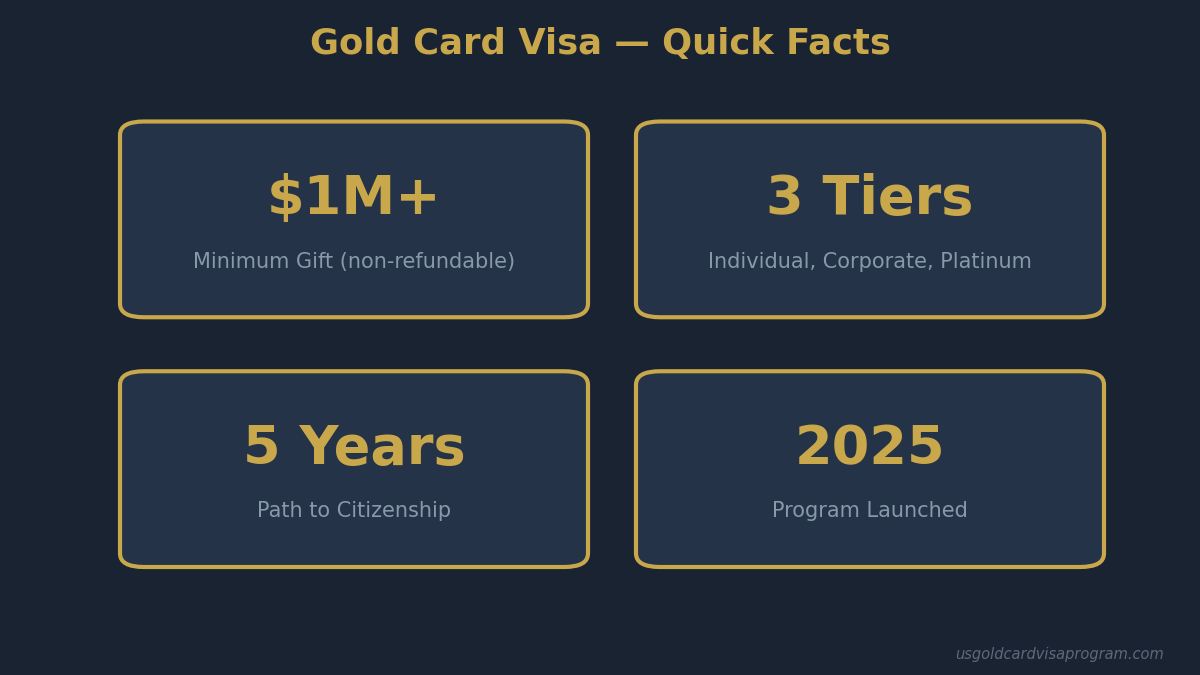
The program is modeled in part on similar “golden visa” programs that have operated successfully in countries such as Portugal, Greece, and the United Arab Emirates. However, the US Gold Card stands apart due to the scale of the financial gift required and the significance of the residency rights conferred. The program aims to attract ultra-high-net-worth individuals who can contribute meaningfully to the American economy while simplifying the often complex and unpredictable immigration process that currently exists.
The Gold Card Visa program is LIVE — it launched in December 2025 and is actively accepting applications at trumpcard.gov. The application form is the I-140G. Payment is a non-refundable gift to the Department of Commerce, made AFTER vetting is complete. As the program continues to scale, procedures and processing timelines are still being refined. Prospective applicants should monitor official government channels and consult qualified immigration attorneys for the latest updates.
Q: How much does the Gold Card Visa cost?
The US Gold Card Visa costs $1 million per person as a non-refundable gift, plus a $15,375 processing fee per person. This is not an investment — it is a gift to the US Department of Commerce. Each family member needs their own $1M gift and $15,375 fee. A family of 4 would need approximately $4M in gifts plus $61,500 in processing fees. A separate $5 million Platinum tier has been announced but is NOT YET AVAILABLE — it is waitlist-only, requires Congressional approval, and is a separate non-immigrant product. At the $1 million per-person level, the Gold Card is among the most expensive immigration programs in the world, reflecting both the value of US permanent residency and the government’s intent to attract financially qualified applicants.
In addition to the $1M gift and $15,375 processing fee per person, applicants should anticipate additional costs associated with the application process itself. These may include legal fees for immigration attorneys, costs for document preparation and translation, fees for background checks and security screenings, and potential advisory fees from financial consultants who assist with source-of-funds documentation. While the exact ancillary costs will depend on individual circumstances, prospective applicants should budget accordingly and work with qualified professionals to understand the full financial commitment involved.
It is worth noting that program details may evolve as the program matures. Applicants should verify current requirements at trumpcard.gov and work with qualified professionals to understand the full financial commitment before making binding decisions.
Q: Is the Gold Card Visa program open for applications?
Yes, the Gold Card Visa program is LIVE. It launched in December 2025 and is actively accepting applications through the official portal at trumpcard.gov using Form I-140G. Payment (a non-refundable gift to the Department of Commerce) is made AFTER vetting is complete. This is the only authorized application channel. Any entity claiming to accept Gold Card Visa applications through other portals or mechanisms is not operating under official government authorization, and applicants should exercise extreme caution regarding such claims.
As a live program that launched in December 2025, processing procedures and timelines are still being refined. Government agencies responsible for immigration processing are actively developing and improving application workflows, security vetting protocols, and adjudication standards. Applicants who are interested in the program are encouraged to work with qualified immigration attorneys who can provide guidance on current requirements and help navigate the application process.
Q: Who created the Gold Card Visa program?
The Gold Card Visa program has been developed as part of broader federal government efforts to modernize and expand pathways for immigration to the United States. The program has received strong support from senior government officials and policymakers who see it as a mechanism to attract global wealth and talent to the American economy. The initiative reflects a policy perspective that the United States should compete more aggressively with other nations for high-net-worth immigrants.
The development of the Gold Card program involves multiple government stakeholders, including those responsible for immigration policy, economic development, and national security. The program uses existing EB-1A and EB-2 NIW visa categories rather than creating a new visa type. It was formally launched in December 2025 with applications accepted at trumpcard.gov via Form I-140G. Prospective applicants should rely only on official government announcements for authoritative information about the program’s governance structure and any future changes.
Q: Is the Gold Card payment refundable?
The Gold Card Visa payment is non-refundable. The $1 million per-person gift plus $15,375 processing fee is a gift to the US Department of Commerce — it is not an investment and there is no return on it. This is a critical distinction from the EB-5 program where funds are invested in projects or enterprises and may eventually be returned. The Gold Card payment is structured as a direct gift to the government, not a recoverable investment in a business or fund. Payment is made AFTER vetting is complete.
Since payment is made after vetting, applicants who do not pass vetting would not have made payment yet. However, the exact refund policies for various scenarios — such as issues discovered after payment, incomplete processing, or program changes — should be clarified with qualified legal counsel. Given the magnitude of the financial commitment ($1M per person plus fees), understanding the payment and refund process in its entirety is essential before proceeding with an application.
Eligibility and Requirements
Q: Who qualifies for the Gold Card Visa?
The Gold Card Visa is available to foreign nationals who can demonstrate the financial capacity to make the required $1 million per-person gift (plus $15,375 processing fee per person) and who pass comprehensive background and security checks. Unlike the EB-5 program, which requires investment in a specific commercial enterprise that creates jobs, the Gold Card program has a more straightforward financial qualification standard centered on the applicant’s ability to make the required gift from lawfully obtained funds. The program uses existing EB-1A or EB-2 NIW visa categories.
Applicants will need to demonstrate that their funds were acquired through legitimate means, which will require detailed source-of-funds documentation. Additionally, standard immigration admissibility requirements will apply, meaning applicants must not have disqualifying criminal histories, security concerns, or health-related grounds of inadmissibility. The program is designed to attract legitimate high-net-worth individuals, including successful entrepreneurs, business owners, and other individuals of substantial financial means from around the world.
Prospective applicants should begin working with qualified immigration attorneys and financial advisors well in advance to ensure their financial profiles and personal backgrounds align with anticipated program requirements. Early preparation of source-of-funds documentation and background materials can help position applicants for a smoother application process.
Q: Are there country restrictions?
The specific country eligibility rules for the Gold Card Visa program have not been finalized. However, as with all US immigration programs, applicants from certain countries may face additional scrutiny or restrictions based on US foreign policy considerations, sanctions regimes, and national security concerns. Citizens of countries subject to comprehensive US sanctions, for example, may face significant obstacles or outright ineligibility.
It is also possible that the program will implement geographic diversity provisions or caps to ensure that the program serves a broad international applicant pool rather than being dominated by applicants from a single country or region. Such provisions are common in other US immigration programs and would be consistent with broader immigration policy objectives. Applicants from all countries are encouraged to consult with qualified immigration attorneys who can assess country-specific eligibility considerations once the program’s official rules are published.
Q: Can I apply if I already have a US visa?
Holding an existing US visa, such as a B-1/B-2 tourist visa, an H-1B work visa, an L-1 intracompany transfer visa, or an E-2 treaty investor visa, is not expected to disqualify an individual from applying for the Gold Card Visa. In fact, many prospective Gold Card applicants are likely to be individuals who already have some form of US immigration status and are seeking to upgrade to permanent residency through the Gold Card pathway.
However, the interaction between existing visa status and a pending Gold Card application will depend on the specific rules and procedures established for the program. Applicants currently in the US on nonimmigrant visas will need to understand whether they can adjust status domestically or whether they must apply through consular processing abroad. These procedural details will be crucial for applicants who wish to maintain their current US presence while pursuing Gold Card residency. Consulting a qualified immigration attorney who understands both existing visa categories and the emerging Gold Card framework will be essential for navigating these complexities.
Q: Is there an age requirement?
The proposed Gold Card Visa framework has not publicly specified minimum or maximum age requirements for primary applicants. In general, US immigration programs do not impose upper age limits on applicants, and it would be unusual for the Gold Card program to introduce such restrictions. The primary qualification criteria are expected to center on financial capacity and admissibility rather than age.
That said, applicants must be legal adults capable of entering into binding financial agreements, which typically means being at least 18 years of age. Minor children are not automatically included — each family member needs their own $1 million gift and $15,375 processing fee, with a parent or guardian managing the application on behalf of minors. The absence of restrictive age requirements is consistent with the program’s goal of attracting qualified applicants regardless of where they are in their careers or lives, whether they are active business leaders or retired individuals seeking to establish residency in the United States.
Q: Do I need to speak English?
There is no indication that the Gold Card Visa program will require English language proficiency as a condition of eligibility. Unlike the US naturalization process, which requires applicants for citizenship to demonstrate a basic understanding of English, the Gold Card Visa is a residency program and is not expected to impose language requirements at the application stage.
This approach is consistent with other immigration programs globally, which typically focus on financial qualifications and background checks rather than language skills. High-net-worth applicants come from diverse linguistic backgrounds, and imposing language requirements could unnecessarily limit the applicant pool. However, applicants should be aware that if they later pursue US citizenship through naturalization, English language requirements will apply at that stage. Working with bilingual attorneys and advisors can help non-English-speaking applicants navigate the application process effectively.
Free Gold Card Visa Guide
Get our Gold Card guide with cost breakdowns, timelines, and attorney tips. Delivered instantly to your inbox.
No spam. Unsubscribe anytime.
Family and Dependents
Q: Can my spouse be included?
Each family member — including your spouse — must make their own separate $1 million gift and pay their own $15,375 processing fee. Spouses are NOT automatically included as free derivative beneficiaries. Unlike some other immigration programs where a spouse is included at no additional cost, the Gold Card Visa requires each person to independently qualify and pay. A married couple would need $2M in gifts plus $30,750 in processing fees.
Each spouse must independently go through the vetting process and submit their own I-140G application. Both spouses will need to provide their own source-of-funds documentation, pass background checks, and complete all required steps individually. Once approved and payment is made, each person receives their own permanent residency. Prospective applicants who are married should ensure that both spouses’ documentation — including identity documents, background information, source-of-funds evidence, and any necessary medical examinations — is prepared as separate, independent applications.
Q: Are children included in the application?
Children are NOT included for free. Each child also requires their own separate $1 million gift and $15,375 processing fee. A family of 4 (two parents and two children) would need approximately $4 million in gifts plus $61,500 in processing fees. This is a significant departure from programs like EB-5 where minor children are included as derivative beneficiaries at no additional cost.
Since each family member applies independently, the traditional “aging out” concern (where a child turns 21 during processing and loses derivative status) works differently with the Gold Card. Each person’s application stands on its own. However, families should still plan carefully around timing, especially for children approaching adulthood who will need their own $1M gift and fee. Consult a qualified immigration attorney to develop a coordinated family application strategy that accounts for each member’s individual timeline and funding requirements.
Q: Can my parents qualify as dependents?
Under current US immigration law, parents are generally not eligible as derivative beneficiaries on immigration petitions filed by their children. This restriction applies across most visa categories, and it is unlikely that the Gold Card Visa program will create an exception to this established framework. Parents would typically need to pursue their own independent immigration pathway to obtain US residency.
However, once a Gold Card holder obtains permanent residency and eventually naturalizes as a US citizen, they would then be eligible to sponsor their parents for immigrant visas through the family-based immigration system. The family-based sponsorship process for parents of US citizens is classified as an “immediate relative” category, which means there is no annual numerical cap, although processing times can still be significant. For families where multiple generations wish to relocate to the United States, comprehensive immigration planning with a qualified attorney is strongly recommended to explore all available options and develop a coordinated strategy.
Financial Details
Q: Where does the Gold Card payment go?
The Gold Card Visa payment ($1 million per person) is a non-refundable gift made directly to the US Department of Commerce. Unlike the EB-5 program, where funds are directed into specific commercial enterprises or regional center projects, the Gold Card gift is not tied to any investment vehicle or business venture. It is a gift, not an investment — there is no financial return. The funds are deposited into government accounts and allocated according to the program’s statutory framework.
How the gift funds will ultimately be allocated by the Department of Commerce will be determined by the legislation and regulations governing the program. There has been discussion about directing the funds toward infrastructure development, deficit reduction, or other national priorities. For applicants, the key distinction is clear: this is a gift, not an investment. There is no expectation of financial return or repayment of the contributed amount.
Q: Can I pay in installments?
The Gold Card Visa program has not indicated whether installment payment options will be available. The program requires payment AFTER vetting is complete, meaning applicants must be prepared to make the full $1 million gift per person once approved through the vetting process. The government’s interest in securing committed, fully qualified applicants may favor a lump-sum payment requirement.
Prospective applicants should not assume that installment options will be available and should prepare to make the full $1 million gift per person in a single transaction after completing the vetting process. Financial planning with qualified advisors who understand cross-border fund transfers and the regulatory requirements for large international payments will be essential regardless of the payment structure ultimately adopted. Remember: each family member needs their own $1M gift plus $15,375 processing fee, so a family of 4 should prepare approximately $4M+ in available funds.
Q: What source of funds documentation is required?
Applicants should expect rigorous source-of-funds scrutiny consistent with US anti-money laundering standards and the enhanced due diligence applied to high-value transactions. Applicants will need to demonstrate the lawful origin of their $1 million gift through comprehensive financial documentation spanning multiple years. Since each family member must independently provide their own $1M gift, each person may need separate source-of-funds documentation.
Typical source-of-funds documentation in comparable programs includes audited financial statements, tax returns from relevant jurisdictions, corporate ownership records, bank statements showing the accumulation or transfer of funds, documentation of asset sales or business proceeds, inheritance records if applicable, and sworn declarations explaining the applicant’s financial history. The documentation requirements may vary depending on the source of funds, as wealth derived from business ownership requires different supporting evidence than wealth from real estate, inheritance, or other sources. Engaging a qualified financial advisor and immigration attorney to compile and organize source-of-funds documentation well in advance is strongly recommended.
Q: Can I use borrowed funds?
Whether the Gold Card Visa program permits applicants to use borrowed or leveraged funds for the $1 million gift is not yet clear. In the context of the EB-5 program, the use of lawfully obtained loan proceeds is permitted under certain conditions, provided the borrower has personal liability for the debt and the loan is secured by assets owned by the applicant. The Gold Card program may adopt similar or different standards.
Given the non-refundable nature of the Gold Card gift, lenders may be reluctant to extend financing for this purpose, as the loan would not be secured by a recoverable asset — the gift has no financial return. Applicants considering the use of borrowed funds should be aware that the program may require demonstration of personal net worth or liquid assets sufficient to cover the gift regardless of whether borrowing is involved. Consulting with both immigration counsel and financial advisors about the feasibility and compliance implications of using borrowed funds is essential before pursuing this approach.
Q: Is the payment tax-deductible?
The tax treatment of the Gold Card Visa gift will depend on the specific tax laws of the applicant’s country of residence and US tax law. In general, gifts made to a government in exchange for immigration benefits are not typically deductible as a business expense or charitable contribution under US tax principles. The gift is more analogous to a government fee than a deductible expenditure.
However, the tax implications could vary significantly based on the applicant’s individual tax situation, country of tax residence, and any applicable tax treaties between their home country and the United States. Some jurisdictions may treat the gift differently for local tax purposes. Applicants should engage qualified tax professionals with expertise in both their home country’s tax laws and US tax law to understand the full tax implications of the Gold Card gift before committing. Tax planning should be an integral part of the overall Gold Card application strategy, not an afterthought.
Process and Timeline
Q: How long does the application process take?
The Gold Card Visa program launched in December 2025 and is LIVE at trumpcard.gov. Official processing timelines are still being established as the program scales. However, based on comparable immigration programs and the complexity of adjudicating high-value applications, prospective applicants should prepare for a process that could take several months to over a year from application submission to final approval. Applications use Form I-140G.
The processing timeline will likely depend on multiple factors, including the volume of applications received, the thoroughness of security and background checks, the completeness of submitted documentation, and the staffing and capacity of the adjudicating agency. Government officials have expressed an intent to make the Gold Card process more efficient and predictable than existing immigration pathways, but the actual processing timelines will become clearer as the program processes its first wave of applications. Applicants should plan conservatively and avoid making irreversible life or business decisions based on assumed processing speeds.
Q: What documents do I need?
While the official document checklist for the Gold Card Visa has not been released, applicants can anticipate needing a comprehensive set of personal, financial, and legal documents. Standard requirements across comparable immigration programs typically include a valid passport, birth certificate, marriage certificate if applicable, police clearance certificates from all countries of residence, medical examination results from an authorized physician, and detailed financial documentation demonstrating the source and availability of the required $1 million gift.
Financial documentation will likely be the most extensive component and may include several years of personal and business tax returns, audited financial statements for any businesses owned, bank statements, investment account records, property valuations, and a detailed narrative explaining how the applicant accumulated their wealth. All documents not in English will need to be professionally translated and may require authentication or apostille certification depending on the country of origin. Compiling and organizing these documents thoroughly will give applicants a significant advantage in submitting a complete and well-prepared application.
Q: Do I need an immigration attorney?
While there is no legal requirement to retain an immigration attorney for any US visa application, working with a qualified and experienced immigration lawyer is strongly recommended for the Gold Card Visa given the complexity and financial magnitude of the program. A non-refundable gift of $1 million per person demands meticulous preparation, and errors or omissions in the application could have serious financial and legal consequences.
An experienced immigration attorney can help applicants understand current program requirements, prepare and organize the extensive documentation package (including the I-140G form), navigate source-of-funds compliance requirements, coordinate with tax advisors and financial planners, communicate with government agencies on the applicant’s behalf, and address any issues or requests for evidence that arise during processing. When selecting an attorney, applicants should look for professionals with specific experience in EB-1A, EB-2 NIW, or Gold Card cases, a track record of successful case outcomes, and familiarity with the unique challenges faced by high-net-worth international clients. Verify that any attorney is licensed and in good standing with their state bar association.
Q: Is there an interview required?
The interview requirements for the Gold Card Visa program have not been officially announced. Many US immigration programs require an in-person interview as part of the adjudication process, either at a US consulate abroad or at a USCIS office domestically, and it would be reasonable to expect that Gold Card applicants will be subject to a similar requirement given the significance of the immigration benefit being conferred. Note that each family member applying separately would likely need their own interview.
If interviews are required, applicants should prepare thoroughly by reviewing their application materials, understanding the source and history of their funds, and being ready to answer detailed questions about their background, intentions, and financial situation. An immigration attorney can help applicants prepare for the interview by conducting practice sessions and identifying potential areas of inquiry. The interview is typically the final substantive step in the adjudication process, and thorough preparation can help ensure a smooth and successful outcome.
After Approval
Q: What rights do Gold Card holders receive?
Gold Card Visa holders are expected to receive permanent resident status in the United States, commonly known as a “green card.” Permanent residents enjoy a broad range of rights, including the right to live and work anywhere in the United States without restriction, the right to own property, the right to operate businesses, access to US educational institutions, and the ability to travel freely in and out of the country, subject to certain limitations on the duration of absences.
Permanent residents also receive protection under US law and have access to the US legal system. They can sponsor certain family members for immigration benefits and may be eligible for various federal and state programs after meeting residency duration requirements. However, permanent residents do not have the right to vote in federal elections or hold certain government positions reserved for US citizens. They are also required to maintain their permanent resident status by not abandoning their US domicile, which generally means maintaining a home and physical presence in the United States and not spending extended periods abroad. Understanding the full scope of rights and responsibilities that come with permanent residency is an important part of the decision-making process for prospective applicants.
Q: Can I eventually become a US citizen?
Yes, permanent residents in the United States are generally eligible to apply for naturalization, which is the process of becoming a US citizen, after meeting certain requirements. The standard pathway requires five years of continuous permanent residence in the United States, physical presence in the country for at least half of that period, good moral character, and the ability to demonstrate basic knowledge of English and US civics through standardized tests administered as part of the naturalization interview.
For Gold Card holders, the pathway to citizenship would follow the same naturalization process available to all permanent residents. There is no indication that the Gold Card program will create an accelerated or alternative route to citizenship. Applicants should be aware that US citizenship carries significant implications, including worldwide tax obligations and potential requirements to renounce previous citizenships depending on the laws of their home country. The decision to pursue citizenship should be made carefully with the guidance of qualified legal and tax professionals who can help the applicant understand the full scope of benefits and obligations associated with becoming a US citizen.
Q: Will I be subject to US taxes?
Yes, US permanent residents are subject to US federal income tax on their worldwide income, regardless of where that income is earned. This is a fundamental aspect of US tax law that applies to all permanent residents from the moment they establish residency, and it represents one of the most significant ongoing obligations associated with obtaining a green card through the Gold Card program or any other immigration pathway.
The US worldwide taxation system means that Gold Card holders will need to report all income from all sources globally, including foreign business income, investment returns, rental income, capital gains, and any other taxable income. They will also be subject to extensive reporting requirements for foreign financial accounts and assets under laws such as FBAR (Foreign Bank Account Report) and FATCA (Foreign Account Tax Compliance Act). Failure to comply with these reporting requirements can result in severe penalties. Prospective Gold Card applicants must engage qualified international tax professionals before obtaining permanent residency to understand their tax obligations, implement appropriate planning strategies, and ensure full compliance with US tax law from the outset. Tax planning is not optional — it is an essential component of responsible immigration planning for high-net-worth individuals.
Q: Is the Gold Card payment an investment?
No — the Gold Card payment is a non-refundable gift, not an investment. This is one of the most common misconceptions about the program. Unlike the EB-5 visa where you invest money into a commercial enterprise (and may eventually get your capital back), the Gold Card requires a $1 million gift per person to the US Department of Commerce. There is no financial return, no equity stake, no business ownership, and no repayment. The money is a gift to the US government in exchange for the opportunity to obtain permanent residency through existing EB-1A or EB-2 NIW visa categories. Think of it as a fee, not an investment. This distinction matters for tax planning, financial planning, and setting expectations about what you receive in return.
Q: Do family members get included for free?
No — each family member needs their own separate $1 million gift plus $15,375 processing fee. This is another critical misconception. Unlike the EB-5 program where your spouse and unmarried children under 21 are included as derivative beneficiaries at no additional cost, the Gold Card Visa requires every person to independently apply and pay. Here is what this means in practice:
- Individual: $1,000,000 gift + $15,375 fee = $1,015,375
- Couple: $2,000,000 in gifts + $30,750 in fees = $2,030,750
- Family of 4: $4,000,000 in gifts + $61,500 in fees = $4,061,500
Each person must also independently pass vetting, submit their own I-140G form, and provide their own source-of-funds documentation. Payment for each person is made AFTER their individual vetting is complete. Families should plan their applications and finances carefully with a qualified immigration attorney.
Related: Gold Card Lawsuit: Legal Challenges | Gold Card for Crypto Entrepreneurs
📋 Free Download: The Complete Gold Card Visa Guide 2026
Get our comprehensive PDF guide — Gold Card vs EB-5, qualification checklist, attorney selection guide, and more.
No spam. Unsubscribe anytime.
Related: Trump Gold Card Processing Times: What Attorneys Actually Say vs. Government Claims
Stay Updated on Gold Card Visa Changes
Get real-time updates on policy changes, processing times, and legal developments. Free newsletter, no spam.
About the Editorial Team
This article was researched and written by the editorial team at usgoldcardvisaprogram.com. We specialize in US immigration programs and provide well-researched, regularly updated content. Our information is sourced from official government publications, immigration law firms, and verified policy documents. This content does not constitute legal or financial advice.
Need Help Finding the Right Immigration Attorney?
The Gold Card requires specialized legal expertise. We've put together a guide on what to look for.
Find a Gold Card Attorney →